
Analytical Guide
Peptide-Related Impurities: Formation, Detection and Interpretation
A researcher's guide to sequence variants, oxidation, stereochemical impurities, co-elution, and the complementary methods used to investigate them.
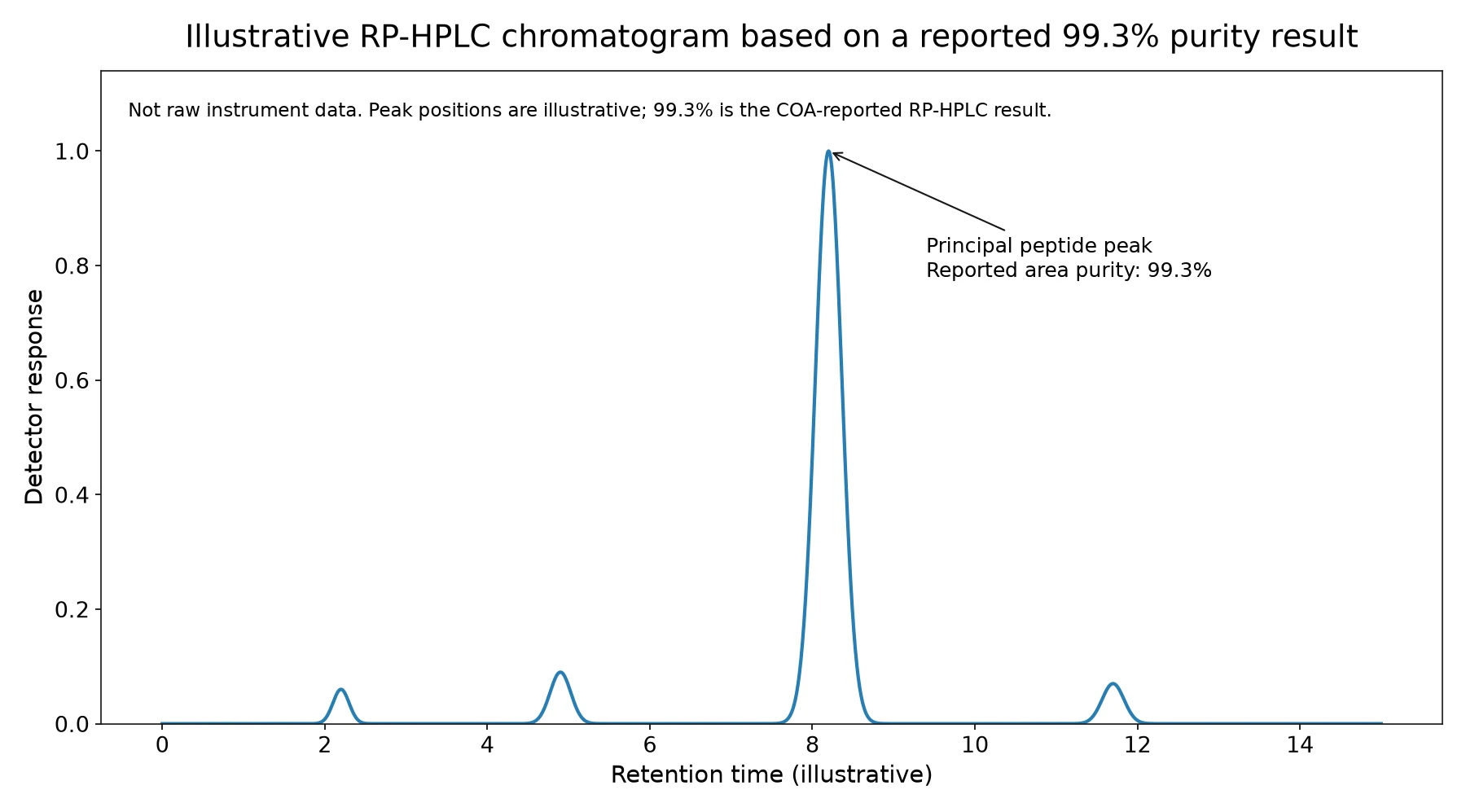
Peptide-related impurities are molecular variants that remain structurally similar to the target peptide but differ in sequence, chemical modification, stereochemistry, or association state. They may form during synthesis, cleavage, purification, finishing, handling, or storage. No single analytical result necessarily detects and identifies every class.
Quick answer
RP-HPLC or UPLC can reveal many separated related species. LC-MS and HRMS add molecular-mass evidence, while MS/MS, peptide mapping, chiral methods, or alternative separations may be needed for sequence location, isomeric, or stereochemical questions. Interpretation should keep detection, identification, and quantitation separate.
| Impurity class | Typical origin | Examples | Main analytical challenge |
|---|---|---|---|
| Sequence variants | Peptide assembly | Deletion, truncation, insertion | May closely resemble the target peptide |
| Chemical variants | Synthesis or degradation | Oxidation, deamidation, hydrolysis | Small changes in retention or mass |
| Isomeric variants | Side reactions | Isomerization, aspartimide-related products | May be isobaric or difficult to resolve |
| Stereochemical variants | Starting materials or synthesis | Epimers, racemized residues | Can have the same molecular mass as the target |
| Higher-molecular-weight species | Cross-linking or association | Dimers, oligomers, aggregates | May require a different separation approach |
What is a peptide-related impurity?
A peptide-related impurity is structurally connected to the expected peptide but differs in one or more chemical or structural features. It may lack a residue, contain an extra residue, carry an oxidized side chain, have an altered linkage, or differ at a stereocenter while retaining much of the target structure.
This category is distinct from non-peptide components such as residual solvents, elemental impurities, counterions, and water. USP General Chapter <1503> and the current EMA synthetic-peptide guideline are useful technical frameworks for distinguishing these attributes. They are cited here for analytical context, not as automatic regulatory requirements for research-use-only materials.
Where peptide-related impurities form
An impurity profile reflects both sequence and process. Related species can arise during chain assembly, deprotection and cleavage, purification and finishing, or later through chemical degradation. Peptide length, amino-acid composition, protecting groups, coupling efficiency, and processing environment can all change which variants are plausible.
- Assembly: incomplete coupling, unintended insertion, or sequence-order events.
- Cleavage and deprotection: chemically sensitive residues may undergo side reactions.
- Purification and finishing: closely related species can be difficult to resolve completely.
- Handling and storage: oxidation, deamidation, hydrolysis, or association may develop over time.
Sequence variants
Deletion and truncated sequences
A deletion sequence lacks one or more expected residues, while a truncated sequence contains only part of the intended chain. Incomplete coupling followed by continued assembly can produce deletion variants; interrupted elongation or incomplete removal can leave shorter sequences. Their physicochemical similarity to the target can lead to partial overlap or co-elution.
Insertion and rearranged sequences
An insertion variant includes an additional residue not present in the intended sequence. Other assembly events can change sequence order. These variants often change molecular mass, making LC-MS useful, but intact mass alone may not locate the change. MS/MS or peptide mapping can provide additional sequence-position evidence.
Chemically modified peptide variants
Oxidation products
Oxidation can occur during production, purification, handling, or storage. Susceptibility depends on sequence and environment; methionine, cysteine, tryptophan, tyrosine, and histidine can be relevant under particular conditions. Oxidation may alter mass, chromatographic behavior, or both while leaving the nominal amino-acid sequence unchanged.
Deamidation, isomerization, and aspartimide-related species
Deamidation can affect asparagine and, in some settings, glutamine. Aspartate-containing sequences may also form aspartimide during Fmoc solid-phase peptide synthesis. Subsequent hydrolysis, rearrangement, or epimerization can generate several related species. Some products have the same or nearly the same intact mass as the target, so mass agreement alone may not distinguish them.
Stereochemical impurities
Racemization during synthesis or stereochemical variation in a starting amino acid can produce an epimeric impurity. Converting an L-amino-acid residue to its D-isomer does not change elemental formula or molecular mass, so intact-mass MS may still show the expected value.
Depending on the analytical question, chiral chromatography, suitably developed LC-MS/MS, amino-acid analysis after appropriate treatment, or another stereochemically discriminating method may be necessary.
Dimers, oligomers, and aggregates
Some peptides can form covalent or non-covalent higher-molecular-weight species. Depending on sequence and conditions, these may include dimers, oligomers, aggregates, or cross-linked forms. Cysteine-containing sequences can be especially relevant where unintended disulfide formation or exchange is possible.
A covalent dimer and a non-covalent aggregate do not necessarily require the same analytical technique. The material, suspected mechanism, and method conditions should define the investigation rather than grouping every larger species under one undifferentiated label.
How RP-HPLC detects peptide impurities
RP-HPLC separates components according to their behavior under a defined chromatographic method. A related impurity appears as a distinct peak only when it is sufficiently separated and detectable under those conditions. Co-eluting species can contribute to the apparent principal peak, while weakly detected components may be underrepresented.
Different separations can reveal different parts of an impurity profile. Published cyclic-peptide work comparing HILIC and reversed-phase chromatography illustrates why orthogonal selectivity can matter. For area normalization, co-elution, and method dependence, see the HPLC peptide purity analysis guide.
How LC-MS and MS/MS characterize impurities
Chromatography can show that an additional detectable component exists; mass spectrometry can help assess the molecular change that differentiates it from the target. LC-MS or HRMS compares observed mass information with the expected peptide, while MS/MS can add fragment-level evidence about sequence changes or modification sites.
Mass spectrometry also has limits. Stereoisomers and some positional or isomeric variants share the same intact mass. MS therefore complements rather than universally replaces chromatographic, chiral, NMR, or other structural methods. The identity versus purity guide explains these evidentiary boundaries in detail.
Detection, identification, and quantitation are different
- Detection establishes that an analytical signal is present.
- Identification assigns that signal to a sufficiently supported molecular species.
- Quantitation estimates how much of the component is present.
In UV chromatography, equal amounts of the target peptide and an impurity do not always produce equal responses. Accurate impurity measurement may require an established relative response factor. A peak area is an instrumental response; it is not inherently a mass or molar percentage.
Why orthogonal impurity profiling matters
Closely related peptide species can challenge any single technique. RP-HPLC can separate many variants but can miss co-eluting species. Intact MS detects many mass differences but cannot distinguish every isomer or epimer. MS/MS adds structural evidence without replacing every separation method, while chiral techniques address questions conventional intact-mass analysis cannot resolve.
ICH Q2(R2) recognizes that a combination of procedures may provide the necessary specificity or selectivity when one method is insufficient. As an analytical principle, this supports a fit-for-purpose combination of chromatographic and structural evidence for peptide impurity profiling.
How researchers should interpret impurity data
- Match the analytical record to the correct material and batch.
- Identify the method, detector, and stated analytical purpose.
- Distinguish characterized impurities from unidentified peaks.
- Review whether the method adequately separates the relevant species.
- Consider co-elution, detection sensitivity, and response-factor differences.
- Read molecular-identity evidence separately from chromatographic purity.
- Do not assume one result excludes all sequence, chemical, or stereochemical variants.
The peptide COA review guide provides a complete Material → Lot → Test → Method → Specification → Result workflow. The broader analytical testing guide covers identity, microbial quality, and trace-contaminant questions outside peptide-related impurity profiling.
Verifying research materials through analytical transparency
For laboratory researchers, understanding impurity profiles is essential for maintaining experimental reproducibility. High-purity research materials should be evaluated alongside comprehensive analytical data, including mass spectrometry and HPLC chromatograms, to account for potential co-eluting or isobaric species.
Vector E Lab publishes genuine lot-specific documentation in its Certificate of Analysis library where available. Researchers can review those records alongside the applicable research-material catalogue page and the stated analytical specifications. A certificate should support only the particular batch and measurements it identifies.
Frequently asked questions
Is every secondary HPLC peak a peptide-related impurity?
No. A secondary signal may be an analytical artifact, another detectable process-related component, a peptide-related species, or another substance. Peak area alone does not establish identity.
Can a peptide-related impurity have the same molecular mass as the target?
Yes. Stereochemical variants and some positional or isomeric forms can share the same molecular mass. Intact-mass agreement therefore cannot exclude every structurally related impurity.
Does 99% RP-HPLC purity mean only 1% peptide-related impurities are present?
Not necessarily. It means other included peaks accounted for about 1% of the reported chromatographic response under that method. Co-eluting, weakly detected, or unresolved species may not appear as distinct peaks.
Why are peptide sequence variants important?
A sequence variant differs directly from the expected peptide but may retain sufficiently similar chromatographic behavior to complicate separation. Its detection and characterization can require complementary methods.
Can one method identify every peptide-related impurity?
Usually not. Different impurity classes present different analytical challenges, so chromatographic, mass-spectrometric, chiral, or other complementary techniques may be required.
Conclusion: an impurity profile describes more than extra peaks
Peptide-related impurities include sequence variants, chemically modified peptides, stereochemical variants, degradation products, and relevant higher-molecular-weight species. Their similarity to the target peptide makes separation, identification, and quantitation distinct analytical tasks.
A useful review follows expected peptide → plausible related variants → analytical separation → structural characterization → appropriate quantitation. This keeps every conclusion tied to evidence suited to the impurity question.
Research use only
Vector E Lab materials are supplied strictly for laboratory research and analytical examination. They are not intended for clinical use, diagnosis, treatment, disease prevention, or administration to humans or animals. Review the Research-Use Disclaimer.
Analytical Standards Referenced by Vector E Lab
- 1.Enantiomeric purity of synthetic therapeutic peptides: A review — Chirality
- 2.Guideline on the development and manufacture of synthetic peptides — European Medicines Agency
- 3.Regulatory considerations in synthetic peptide characterization: Techniques and compliance — Separation Science Plus
- 4.ICH Q2(R2): Validation of Analytical Procedures — International Council for Harmonisation
- 5.Absolute quantitation of coeluting impurities in peptide drugs using high resolution mass spectrometry — Journal of the American Society for Mass Spectrometry
- 6.Aspartimide formation and its prevention in Fmoc chemistry solid phase peptide synthesis — ChemBioChem
- 7.The critical need for implementing RRF in the accurate assessment of impurities in peptide therapeutics — Analytical Chemistry
- 8.Reference standards to support quality of synthetic peptide therapeutics — Pharmaceutical Research
- 9.USP General Chapter <1503>: Quality Attributes of Synthetic Peptide Drug Substances — United States Pharmacopeia
- 10.Regulatory and analytical considerations for the quality assessment of peptide drugs — Journal of Pharmaceutical Investigation
- 11.Impurity profiling of synthetic cyclic peptides based on orthogonality between HILIC and RP-LC — Journal of Chromatography A
Related products, documentation, and methods
Products and batch documentation
Analytical method guides
- How to read a peptide Certificate of AnalysisA lot-by-lot framework for reviewing identity, RP-HPLC purity, peptide content, specifications, results, and supporting analytical data.
- RP-HPLC purity standards guideHow chromatographic purity is determined and what a ≥ 99.0% release limit does and does not describe.
- Mass spectrometry and analytical testing guideLC-MS identity confirmation, orthogonal testing layers, and how to read the analytical parameters on a Certificate of Analysis.
Research library
Regulatory and compendial references
- USP <621> Chromatography — United States Pharmacopeia
- USP <736> Mass Spectrometry — United States Pharmacopeia
- ICH Q2(R2) Validation of Analytical Procedures — ICH
Reviewing materials for your next study?
Every Vector E Lab compound ships with lot-specific analytical documentation, including HPLC and mass spectrometry data. Products are supplied strictly for in-vitro research use.
Related reading
- Analytical GuidePeptide Identity vs Purity: What HPLC and LC-MS Actually Tell YouUnderstand how HPLC purity, LC-MS identity evidence, and quantitative peptide content answer different analytical questions.
- Analytical GuidePeptide Purity Explained: How to Read HPLC Purity ResultsLearn what a 99% peptide purity result means, how RP-HPLC area purity is calculated, and why purity, identity, and peptide content require s…
- Technical GuideHow to Read a Peptide COA: Purity Testing, HPLC & Mass SpectrometryLearn how to evaluate a peptide Certificate of Analysis by checking batch traceability, RP-HPLC purity, mass-spectrometry identity, peptide …