
Analytical Guide
Peptide Purity Explained: How to Read HPLC Purity Results
Learn what a 99% peptide purity result means, how RP-HPLC area purity is calculated, and why purity, identity, and peptide content require separate evidence.
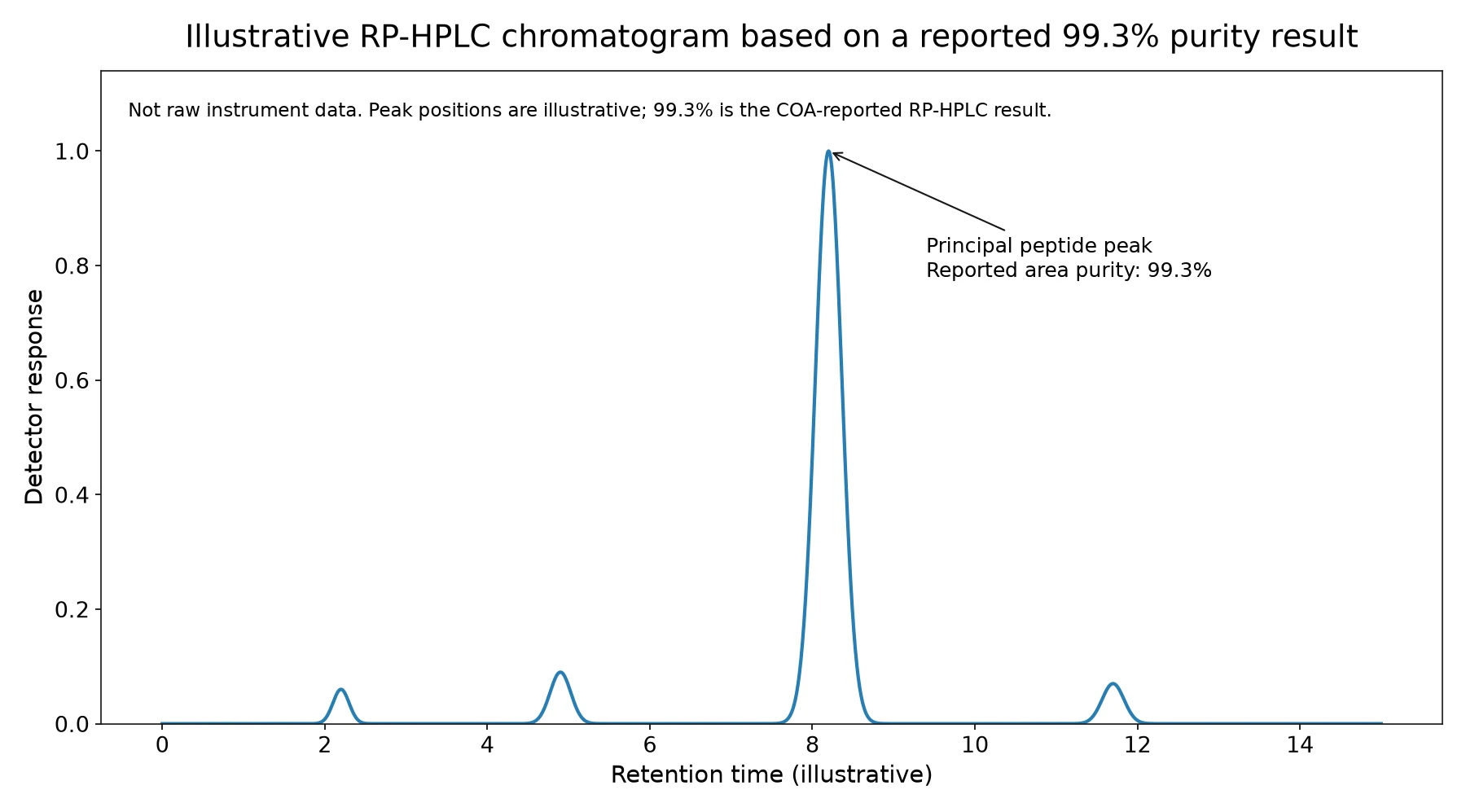
A 99% peptide purity result by RP-HPLC usually means that the main peptide peak produced about 99% of the integrated chromatographic response included in that method. It does not automatically mean that 99% of the total vial mass is the target peptide.
Quick answer
Read an HPLC purity percentage as a method-specific chromatographic result. Then review molecular identity and quantitative peptide content separately, because each answers a different analytical question.
| Measurement | What it tells you | Typical method |
|---|---|---|
| Chromatographic purity | Relative chromatographic response of the main component | RP-HPLC / UPLC |
| Molecular identity | Whether the principal component matches the expected peptide | LC-MS / HRMS |
| Peptide content | Quantitative amount of target peptide | qNMR / AAA / reference-standard assay |
This distinction is the foundation for interpreting peptide purity data. USP General Chapter <1503> treats purity, identity, content, water, counterions, and other attributes as separate quality questions. Because that chapter concerns synthetic peptide drug substances, it is cited here as a technical reference framework—not as an automatic regulatory requirement for research-use-only materials.
What does peptide purity mean?
On many peptide Certificates of Analysis and product specifications, “purity” means chromatographic purity measured by reversed-phase high-performance liquid chromatography (RP-HPLC) or UPLC. The method separates detectable components into peaks, and the detector records a response for each included peak.
The peak assigned to the principal peptide is identified through the analytical method and, where available, supporting identity evidence. Other peaks may represent peptide-related impurities, degradation products, process-related compounds, or other detectable components. A statement such as “RP-HPLC chromatographic purity: 99.1%” is therefore more informative than “purity: 99.1%” because it identifies the measurement that produced the number.
How is HPLC area purity calculated?
A simplified area-normalization calculation is:
Chromatographic area purity (%) = Amain ÷ ΣAi × 100
Here, Amain is the integrated area of the peak assigned to the principal peptide component, and ΣAi is the sum of the integrated peak areas included in the calculation.
If the total included peak area is 1,000 units and the principal peak area is 985 units, the area purity is 98.5%. The correct interpretation is: the primary component accounted for 98.5% of the included chromatographic response under that analytical method. It is not automatically equivalent to 98.5% of everything physically present in the vial.
What HPLC purity does not tell you
HPLC area purity alone does not establish:
- Molecular identity: a dominant chromatographic peak is not independent proof that the component is the expected peptide.
- Total peptide content by mass: area response is not automatically a weight-for-weight assay.
- Water content: moisture can contribute to material mass without appearing as an equivalent peptide peak.
- Counterion content: acetate, trifluoroacetate, or another counterion affects material composition.
- Residual solvents: these generally require an appropriate separate method.
- Every possible contaminant: detectability depends on the method and detector.
- Absence of co-eluting species: an unresolved component can contribute to the apparent main peak.
For broader orthogonal testing context, see the peptide analytical testing guide. The existing HPLC purity standards guide examines method standards and the limits of a headline purity threshold in more depth.
Why HPLC purity is not peptide content
Chromatographic purity and quantitative peptide content answer different questions. Total material mass can include the target peptide, peptide-related impurities, counterions, water, residual process solvents, and other non-peptide material where present.
A conceptual content calculation is:
Target peptide content (% w/w) = mass of target peptide ÷ total material mass × 100
For an illustrative 10.0 mg material containing 8.7 mg of target peptide, 0.6 mg of water, 0.5 mg of counterion, and 0.2 mg of other material, the target-peptide mass fraction would be 87% w/w. The same material could show a substantially higher RP-HPLC area-purity result because the two measurements describe different attributes.
When quantitative peptide content matters, an appropriate method may include quantitative NMR, amino-acid analysis, a justified mass-balance approach, or assay against a sufficiently characterized reference standard. Researchers should not derive peptide mass simply by multiplying vial mass by an HPLC area-purity percentage unless the documented analytical framework supports that calculation.
Why the analytical method changes the result
An HPLC purity value depends on the method that generated it. Relevant variables include column chemistry, mobile-phase composition, gradient profile, temperature, flow rate, detection wavelength, injection amount, and integration settings. Changes in these conditions can alter selectivity, peak resolution, and which signals are included in area normalization.
A resolved impurity produces a separate measurable peak. A co-eluting impurity overlaps the principal peak, so some or all of its response may be counted with the apparent main component. ICH Q2(R2) treats specificity and selectivity as important analytical-procedure characteristics. Here, those concepts are used as scientific reference principles rather than claims that pharmaceutical validation requirements automatically apply to research-use-only material.
Relative response factors and peptide impurities
Equal concentrations of different compounds do not necessarily produce equal detector responses. A detector response factor may be expressed as RFi = Ai ÷ Ci, where A is peak area and C is concentration. A relative response factor compares an impurity response with a defined reference response.
Because published methods may define the ratio in opposite directions, the analytical procedure must state how its relative response factor is defined and applied. The practical point is simple: peak area is an instrumental response, and accurate impurity quantitation may require a component-specific correction.
Common peptide-related impurities
Synthetic peptide production and subsequent handling can generate molecular species that closely resemble the target sequence. Depending on the peptide and process, these may include truncated or deletion sequences, incomplete coupling products, oxidation, deamidation, hydrolysis, racemization or epimerization, isomerized species, other modified variants, and—where relevant—dimers or aggregates.
Some related species differ only subtly from the target peptide, and one chromatographic condition may not separate every relevant component. A headline purity value is therefore not a complete molecular characterization.
Purity does not establish molecular identity
A chromatogram can show that one component dominates the detected profile without independently proving that the component is the intended peptide. Molecular identity should be supported by an appropriate identity method, commonly mass spectrometry or another suitable orthogonal technique.
HPLC and mass spectrometry provide complementary evidence: chromatography describes separation and relative response, while mass spectrometry compares observed molecular information with the expected peptide. Neither result should be used as a substitute for the other.
How to read peptide purity on a COA
To evaluate a specific research material, review its lot-specific Certificate of Analysis and the analytical methods reported for that batch. A useful purity entry connects the material and lot with the test, method, acceptance criterion, measured result, and supporting record.
| COA field | What to check |
|---|---|
| Product and batch number | Confirm the certificate matches the material and exact lot under review. |
| Testing date | Identify when the analytical result was generated. |
| Purity specification | Read the predetermined acceptance criterion, not a batch measurement. |
| Batch result | Read the value measured for that specific sample. |
| Analytical method | Confirm whether the result is RP-HPLC, UPLC, or another measurement. |
| Chromatogram | Review sample identification, principal and secondary peaks, and integration context where supplied. |
| Identity evidence | Look for mass-spectrometry or other appropriate evidence separate from purity. |
For an illustrative COA entry:
| COA entry | Illustrative value |
|---|---|
| Purity specification | ≥98.0% |
| Analytical method | RP-HPLC |
| Batch result | 99.2% |
The specification is the acceptance criterion; the batch result is the value measured for the sample. “≥98.0%” should not be treated as the measured result for every batch. The detailed peptide COA review guide explains the complete Material → Lot → Test → Method → Specification → Result workflow.
A practical peptide-purity review checklist
- Identify whether the reported percentage is chromatographic area purity.
- Confirm the analytical method and detector used.
- Separate the batch result from the product specification.
- Review chromatographic resolution and supporting data where available.
- Check whether molecular identity has separate supporting evidence.
- Determine whether quantitative peptide content is relevant to the experiment.
- Review water, counterion, solvent, microbial, or trace-contaminant data only when those attributes were actually tested.
- Match every analytical record to the correct batch.
Conclusion: interpret the measurement, not just the percentage
Peptide purity by RP-HPLC is useful when it is read as a method-specific chromatographic measurement. It describes the relative response attributed to the main component under defined conditions; it does not independently establish molecular identity, quantitative peptide content, total material composition, or the absence of every possible contaminant.
The most reliable review keeps four ideas separate: chromatographic purity → peptide content → molecular identity → material composition. Researchers can then decide which evidence is relevant to their analytical question and review the associated batch documentation without asking one percentage to support conclusions it was not designed to establish.
Frequently asked questions about peptide purity
Does 99% HPLC purity mean that 99% of the vial mass is peptide?
No. It usually means the main peak produced about 99% of the included chromatographic response under that method. Water, counterions, residual solvents, and other material can contribute to total mass without being represented as equivalent peptide signal.
Can two laboratories obtain different purity values for the same peptide?
Yes. Columns, gradients, detection settings, sample preparation, integration rules, and instrument performance can change separation and the reported area percentage. Meaningful comparison requires sufficiently comparable methods.
Can HPLC detect every peptide impurity?
No. Detection depends on the method, detector, separation, and chemical properties of the impurity. Co-eluting, weakly detected, or otherwise unresolved species may require additional analytical approaches.
Is higher HPLC purity proof of correct peptide identity?
No. Purity and identity answer different questions. Molecular identity requires suitable independent evidence, commonly mass spectrometry or another orthogonal identity method.
Why are relative response factors important?
Different peptide-related compounds can produce different detector responses at the same concentration. A defined relative response factor can correct those differences when accurate impurity quantitation requires it.
Research use only
Vector E Lab materials are supplied strictly for laboratory research and analytical examination. They are not intended for clinical use, diagnosis, treatment, disease prevention, or administration to humans or animals. Review the Research-Use Disclaimer.
Analytical Standards Referenced by Vector E Lab
- 1.Mass balance analysis for therapeutic peptides: Case studies, applications, and perspectives — Journal of Pharmaceutical and Biomedical Analysis
- 2.ICH Q2(R2): Validation of Analytical Procedures — International Council for Harmonisation
- 3.The critical need for implementing RRF in the accurate assessment of impurities in peptide therapeutics — Analytical Chemistry
- 4.Reference standards to support quality of synthetic peptide therapeutics — Pharmaceutical Research
- 5.Improvement of analysis and transferability in peptide purification: From HPLC to FPLC and back again — Journal of Peptide Science
- 6.USP General Chapter <1503>: Quality Attributes of Synthetic Peptide Drug Substances — United States Pharmacopeia
Related products, documentation, and methods
Products and batch documentation
Analytical method guides
- How to read a peptide Certificate of AnalysisA lot-by-lot framework for reviewing identity, RP-HPLC purity, peptide content, specifications, results, and supporting analytical data.
- RP-HPLC purity standards guideHow chromatographic purity is determined and what a ≥ 99.0% release limit does and does not describe.
- Mass spectrometry and analytical testing guideLC-MS identity confirmation, orthogonal testing layers, and how to read the analytical parameters on a Certificate of Analysis.
Research library
Regulatory and compendial references
- USP <621> Chromatography — United States Pharmacopeia
- ICH Q2(R2) Validation of Analytical Procedures — ICH
Reviewing materials for your next study?
Every Vector E Lab compound ships with lot-specific analytical documentation, including HPLC and mass spectrometry data. Products are supplied strictly for in-vitro research use.
Related reading
- Analytical GuidePeptide-Related Impurities: Formation, Detection and InterpretationA researcher's guide to sequence variants, oxidation, stereochemical impurities, co-elution, and the complementary methods used to investiga…
- Analytical GuidePeptide Identity vs Purity: What HPLC and LC-MS Actually Tell YouUnderstand how HPLC purity, LC-MS identity evidence, and quantitative peptide content answer different analytical questions.
- Technical GuideHow to Read a Peptide COA: Purity Testing, HPLC & Mass SpectrometryLearn how to evaluate a peptide Certificate of Analysis by checking batch traceability, RP-HPLC purity, mass-spectrometry identity, peptide …