
Analytical Guide
Peptide Identity vs Purity: What HPLC and LC-MS Actually Tell You
Understand how HPLC purity, LC-MS identity evidence, and quantitative peptide content answer different analytical questions.
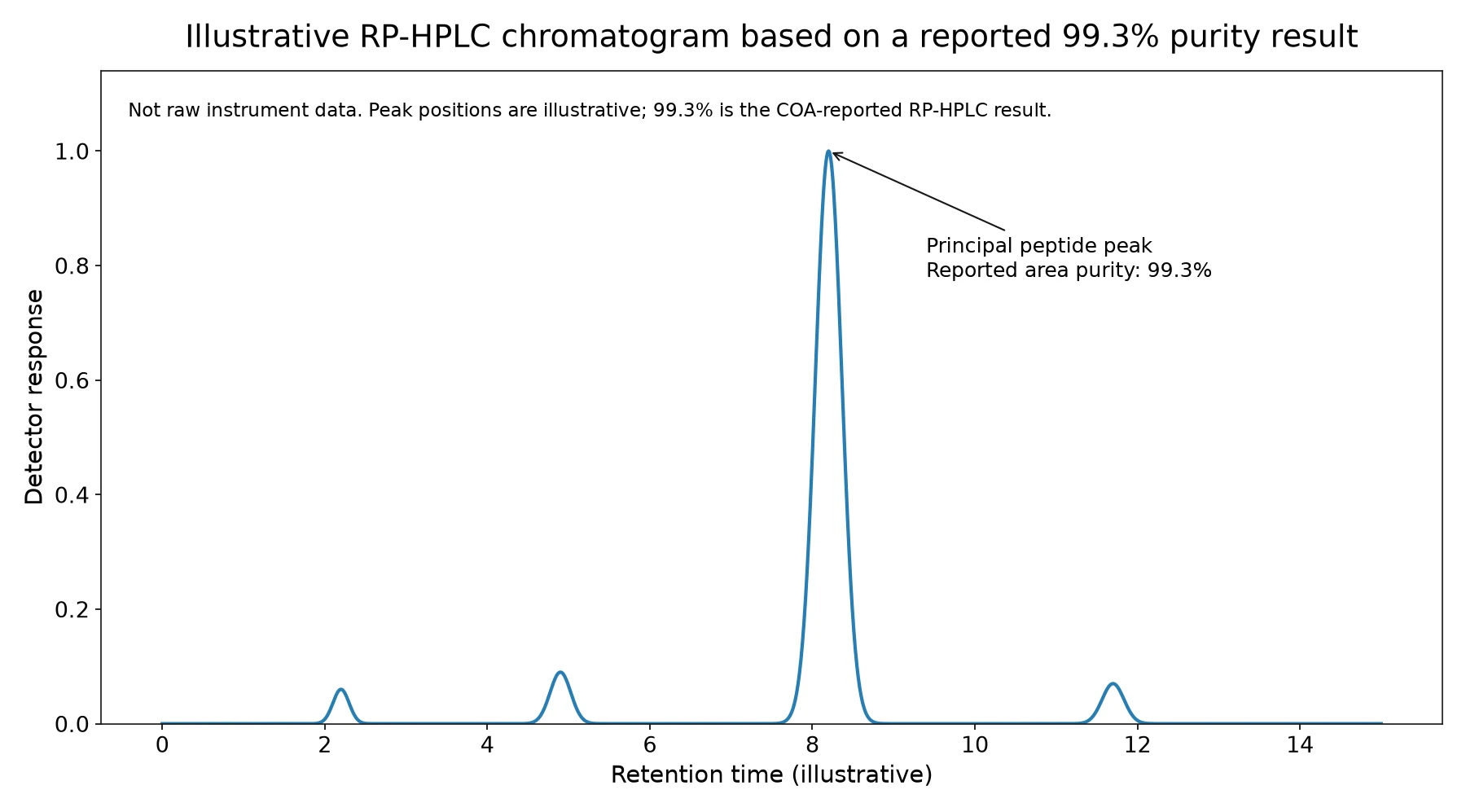
Identity asks whether the analytical evidence is consistent with the expected peptide. Purity asks what proportion of the detected chromatographic response belongs to the main component. Content asks how much target peptide is quantitatively present. These are complementary measurements, not interchangeable descriptions of a research material.
Quick answer
RP-HPLC describes the chromatographic profile but does not independently identify the main peak. LC-MS provides molecular-mass evidence supporting identity, but intact mass alone may not establish every sequence, positional, or stereochemical feature. A defensible review reads both results in the context of the stated methods and the same batch.
| Attribute | Question answered | Typical evidence |
|---|---|---|
| Identity | Is the analyzed material consistent with the expected molecular species? | LC-MS, HRMS, LC-MS/MS, peptide mapping, NMR, or chiral analysis as appropriate |
| Purity | What proportion of the detected chromatographic response is attributed to the main component? | RP-HPLC, UPLC, or another suitable separation method |
| Content | How much target peptide is quantitatively present in the material? | AAA, qNMR, mass balance, or assay against a characterized reference standard |
USP General Chapter <1503>, ICH Q6A, and ICH Q2(R2) treat identity, impurities, content, and method performance as distinct analytical questions. They are cited here as technical reference frameworks, not as automatic regulatory requirements for research-use-only materials.
What does peptide identity mean?
The identity of a synthetic peptide involves more than its product name. The expected structure can include amino-acid sequence, terminal chemistry, disulfide connectivity or cyclization, non-standard residues, conjugations, and defined modifications. An identity method asks whether the observed analytical evidence supports that expected molecular species.
Mass spectrometry is commonly used because observed ions can be compared with the mass calculated from the proposed structure. LC-MS, HRMS, MALDI-TOF-MS, MS/MS, peptide mapping, NMR, and chiral methods can provide different levels of structural evidence. Which combination is appropriate depends on the identity question being asked.
What does peptide purity mean?
Peptide documentation commonly reports chromatographic purity by RP-HPLC or UPLC. The method separates detectable components into peaks, and the reported percentage usually represents the relative detector response assigned to the main component under that method.
A result such as 99% chromatographic purity by RP-HPLC describes chromatographic homogeneity. It does not independently establish the chemical identity of the main peak, and it is not automatically a measurement of target-peptide mass content. The companion guide, Peptide Purity Explained, covers area normalization, co-elution, response factors, and method dependence in detail.
Identity vs purity vs content
The distinction matters because a result can be strong in one category and incomplete in another. A sample can contain a dominant peak without enough evidence to assign that peak to the expected peptide. Conversely, LC-MS can detect a species consistent with the expected mass while chromatography shows additional components.
Quantitative content remains a third question. Water, counterions, residual solvents, and peptide-related material can affect total mass, so neither HPLC area purity nor an intact-mass match automatically reports the amount of target peptide present.
Why 99% HPLC purity does not prove identity
Consider a hypothetical sample with a 99.4% RP-HPLC main-peak area. The chromatogram shows that one component dominates the detected profile under the stated method. It does not, by itself, identify that component.
A non-target peptide, an incorrectly modified peptide, or another species with similar chromatographic behavior could still produce the dominant peak. ICH Q6A notes that a single chromatographic retention time is not generally specific enough for identity and describes combined approaches such as HPLC-MS as more discriminating. That pharmaceutical guidance is used here only for its analytical principle.
What does LC-MS add?
LC-MS adds molecular-mass information that chromatographic peak area alone does not provide. A practical identity workflow is:
Expected sequence and modifications → calculated molecular mass → observed ions → identity assessment
In electrospray ionization, peptides commonly appear as multiply charged ions. The observed mass-to-charge ratio can therefore be substantially lower than the peptide's neutral molecular mass. Charge-state assignment and deconvolution allow the observed molecular mass to be compared with the expected value.
Agreement between calculated and observed intact mass provides important evidence supporting molecular identity when the mass convention, modifications, adducts, and charge states are interpreted correctly. It should not be described as proof of every structural feature.
Why correct molecular mass does not prove complete structure
Different peptide structures can have the same or nearly the same intact mass. Leucine and isoleucine are isobaric, so substituting one for the other does not change elemental composition or intact molecular mass. D- and L-amino-acid forms also share the same mass.
Intact mass may also leave sequence order, modification site, disulfide connectivity, positional isomers, and stereochemical arrangement unresolved. Where those distinctions matter, LC-MS/MS, peptide mapping, chiral analysis, NMR, or another complementary method may be needed. MS/MS provides sequencing information, but its evidentiary scope still depends on coverage and method performance.
Why identity does not prove purity
The distinction is often misunderstood in the opposite direction as well. LC-MS data consistent with the expected intact mass can provide evidence supporting the expected molecular species, but it does not mean that only that species is present.
| Hypothetical component | Relative chromatographic response |
|---|---|
| Expected peptide | 92.0% |
| Related impurity A | 4.0% |
| Related impurity B | 2.5% |
| Other detected components | 1.5% |
In this hypothetical profile, mass-spectrometric evidence could support the identity of the 92.0% principal component while the chromatographic result remains approximately 92%. Accurate identity evidence does not guarantee high chromatographic purity.
How structurally related impurities affect peptide analysis
Peptide-related impurities can resemble the target sequence closely. Depending on the compound and process, they may include deletion or truncated sequences, oxidation products, deamidated variants, isomerized sequences, epimers, or other modified forms.
That structural similarity can make chromatographic separation difficult. A related species may co-elute with the target and contribute to one apparent peak. The practical implication is that chromatographic purity is method-dependent evidence, not confirmation that no other molecular species are present.
Why orthogonal analytical methods matter
No single method answers every structural and compositional question. RP-HPLC describes separation and relative detector response but cannot independently determine molecular identity. Intact MS provides molecular-mass evidence but may not distinguish all isomers or stereochemical forms. Complementary methods are selected because they contribute different evidence about the same material.
ICH Q2(R2) discusses specificity and selectivity: an analytical procedure should distinguish the analyte from relevant interference for its intended purpose. Applied as a scientific principle, this means a purity method needs adequate separation for the impurity question, while an identity method needs enough structural discrimination for the claim being made. See the peptide analytical testing guide for the wider testing framework.
How researchers should read identity and purity data
Review the lot-specific Certificate of Analysis and keep each conclusion attached to the method that supports it. A practical sequence is:
- Confirm that the certificate matches the product and batch under review.
- Identify the method used for molecular-identity evidence.
- Compare theoretical and observed mass using the same stated mass convention.
- Recognize the structural questions that intact mass does not resolve.
- Identify the chromatographic method used for purity and read the percentage as a method-specific area result.
- Review whether co-elution, sensitivity, or selectivity could limit the interpretation.
- Evaluate quantitative content and other material attributes separately when relevant.
The peptide COA guide provides the complete Material → Lot → Test → Method → Specification → Result workflow. Researchers can also review the peptide research-material catalogue and the genuine batch documents available in the COA library.
Three possible analytical scenarios
| Hypothetical scenario | Results | Interpretation |
|---|---|---|
| High purity, insufficient identity evidence | RP-HPLC: 99.3%; identity test: not provided | One component dominates the chromatographic profile, but the main peak's identity is not independently established. |
| Identity supported, lower purity | LC-MS: observed mass consistent with expected peptide; RP-HPLC: 91.8% | Mass evidence supports the expected species while other detectable components remain in the chromatographic profile. |
| Identity and purity supported | LC-MS: observed mass consistent with expected species; RP-HPLC: 99.1% | Both results support the stated identity and high chromatographic homogeneity, but do not automatically establish complete sequence, stereochemistry, quantitative content, or total composition. |
Frequently asked questions
Can a peptide be 99% pure but still have the wrong identity?
Yes. A 99% chromatographic result means one component dominates the detected profile under the stated method. Independent identity evidence is needed to assess whether that component is consistent with the expected peptide.
Does matching molecular mass prove the complete peptide sequence?
No. Intact-mass agreement supports identity, but isobaric residues, stereochemical variants, modification sites, and some positional differences may require complementary structural methods.
Can LC-MS provide information about both identity and impurities?
Yes. LC-MS can support identity assessment and characterize detectable peptide-related species. Its impurity information depends on separation, sensitivity, response, calibration, and method purpose.
Why is HPLC retention time not enough for identity?
Different compounds can show similar retention behavior. A single retention time generally lacks the structural specificity needed to establish peptide identity on its own.
Why should identity and purity appear separately on a COA?
They answer different questions. Separate reporting makes clear which evidence supports molecular identity and which method measures chromatographic purity for that batch.
Conclusion: each result should support one clear claim
Peptide identity and purity provide complementary analytical evidence. Identity data addresses whether the material is consistent with the expected molecular species. Chromatographic purity describes the relative detected response of the principal component and other resolved components under a defined method.
A stronger review follows expected structure → identity evidence → chromatographic purity → relevant complementary characterization. This keeps every interpretation tied to the measurement designed to support it.
Research use only
Vector E Lab materials are supplied strictly for laboratory research and analytical examination. They are not intended for clinical use, diagnosis, treatment, disease prevention, or administration to humans or animals. Review the Research-Use Disclaimer.
Analytical Standards Referenced by Vector E Lab
- 1.Characterization of synthetic peptides by mass spectrometry — Methods in Molecular Biology
- 2.ICH Q6A: Specifications—Test Procedures and Acceptance Criteria — International Council for Harmonisation
- 3.ICH Q2(R2): Validation of Analytical Procedures — International Council for Harmonisation
- 4.Absolute quantitation of coeluting impurities in peptide drugs using high resolution mass spectrometry — Journal of the American Society for Mass Spectrometry
- 5.Reference standards to support quality of synthetic peptide therapeutics — Pharmaceutical Research
- 6.USP General Chapter <1503>: Quality Attributes of Synthetic Peptide Drug Substances — United States Pharmacopeia
- 7.Regulatory and analytical considerations for the quality assessment of peptide drugs — Journal of Pharmaceutical Investigation
Related products, documentation, and methods
Products and batch documentation
Analytical method guides
- How to read a peptide Certificate of AnalysisA lot-by-lot framework for reviewing identity, RP-HPLC purity, peptide content, specifications, results, and supporting analytical data.
- RP-HPLC purity standards guideHow chromatographic purity is determined and what a ≥ 99.0% release limit does and does not describe.
- Mass spectrometry and analytical testing guideLC-MS identity confirmation, orthogonal testing layers, and how to read the analytical parameters on a Certificate of Analysis.
Research library
Regulatory and compendial references
- USP <621> Chromatography — United States Pharmacopeia
- USP <736> Mass Spectrometry — United States Pharmacopeia
- ICH Q2(R2) Validation of Analytical Procedures — ICH
Reviewing materials for your next study?
Every Vector E Lab compound ships with lot-specific analytical documentation, including HPLC and mass spectrometry data. Products are supplied strictly for in-vitro research use.
Related reading
- Analytical GuidePeptide-Related Impurities: Formation, Detection and InterpretationA researcher's guide to sequence variants, oxidation, stereochemical impurities, co-elution, and the complementary methods used to investiga…
- Analytical GuidePeptide Purity Explained: How to Read HPLC Purity ResultsLearn what a 99% peptide purity result means, how RP-HPLC area purity is calculated, and why purity, identity, and peptide content require s…
- Technical GuideHow to Read a Peptide COA: Purity Testing, HPLC & Mass SpectrometryLearn how to evaluate a peptide Certificate of Analysis by checking batch traceability, RP-HPLC purity, mass-spectrometry identity, peptide …