
Technical Guide
How to Read a Peptide COA: Purity Testing, HPLC & Mass Spectrometry
Learn how to evaluate a peptide Certificate of Analysis by checking batch traceability, RP-HPLC purity, mass-spectrometry identity, peptide content, water, counterions, and supporting data.
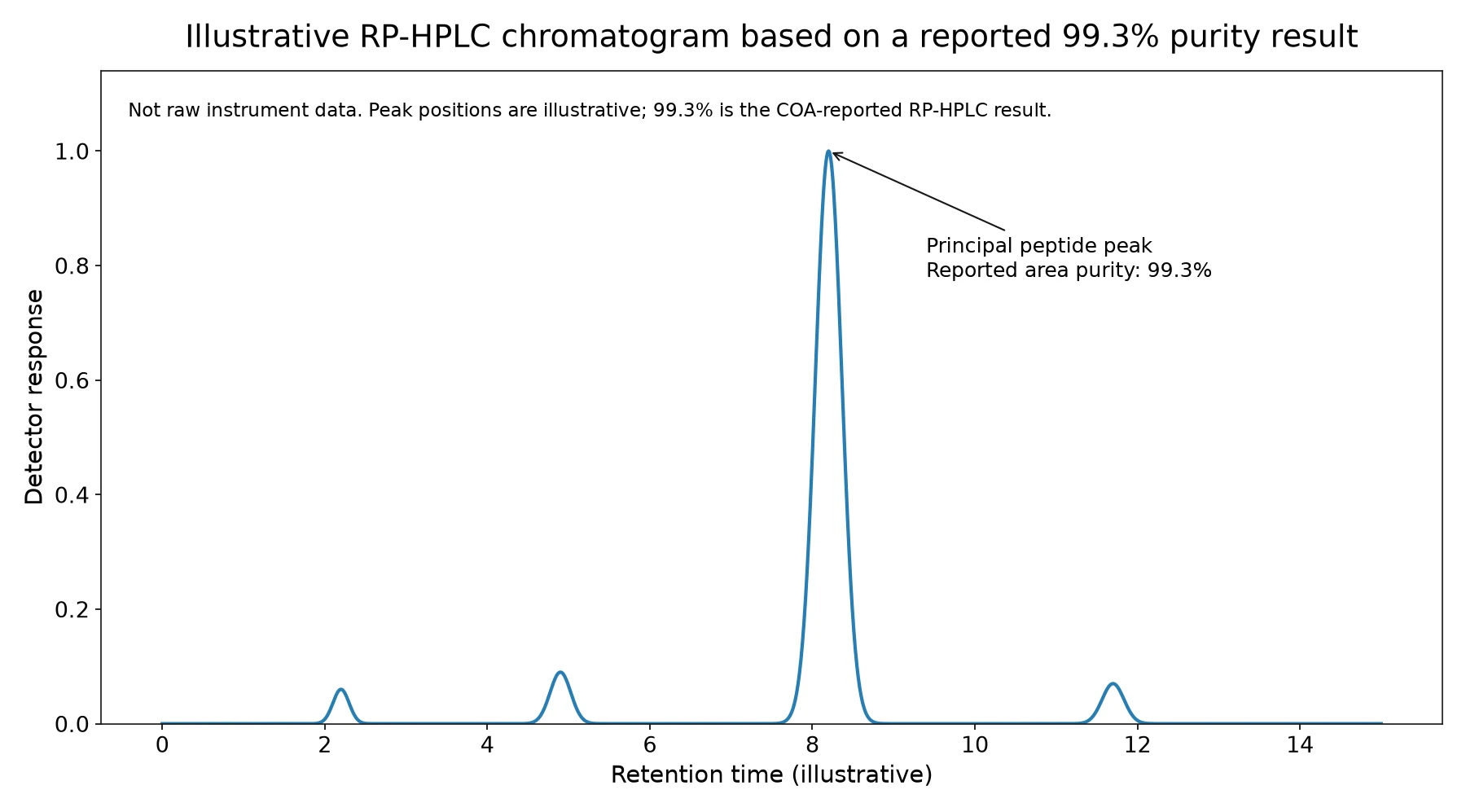
A peptide Certificate of Analysis (COA) is a lot-specific summary of the tests performed on a research material and the results obtained. To read one correctly, first match the peptide and lot, then separate each test, method, specification, and result before interpreting RP-HPLC purity, mass-spectrometry identity, peptide content, water, counterions, and any supporting data.
Key takeaways
- A COA must be traceable to the exact product and lot under review.
- RP-HPLC purity and mass-spectrometry identity answer different analytical questions.
- A 99% HPLC area result does not automatically mean 99% peptide by mass.
- Specifications are acceptance criteria; results are the values measured for the batch.
- Chromatograms and spectra are meaningful only with the relevant method and interpretation.
For laboratories evaluating research materials, the useful question is not simply whether a COA exists. It is whether the document provides enough evidence to connect a specific material and batch to appropriate analytical measurements. Researchers can compare the framework below with the records in the Vector E Lab Certificate of Analysis library.
1. Start with material and batch identification
Before interpreting any numerical result, confirm that the COA belongs to the material being reviewed. Check the product or peptide name, lot or batch number, chemical form, analysis date, and—where relevant—the sequence, terminal modifications, cyclization, conjugation, or other structural features.
- Material name: identifies what the certificate describes.
- Lot or batch number: connects the analytical record to a specific production lot.
- Sequence or structure: defines the expected molecular species when that information is applicable.
- Salt or counterion form: can affect the composition and total mass of the supplied material.
- Testing date: establishes when the reported measurements were generated.
A product-level statement such as “purity ≥98%” is a specification. A lot-specific analytical record reports what was measured for one batch. That distinction is central to experimental traceability and to peptide analytical testing.
2. Separate the test, method, specification, and result
These four COA entries answer different questions and should not be treated as interchangeable.
| COA element | Example | What it tells the researcher |
|---|---|---|
| Test | Chromatographic purity | The attribute evaluated |
| Method | RP-HPLC | How the attribute was evaluated |
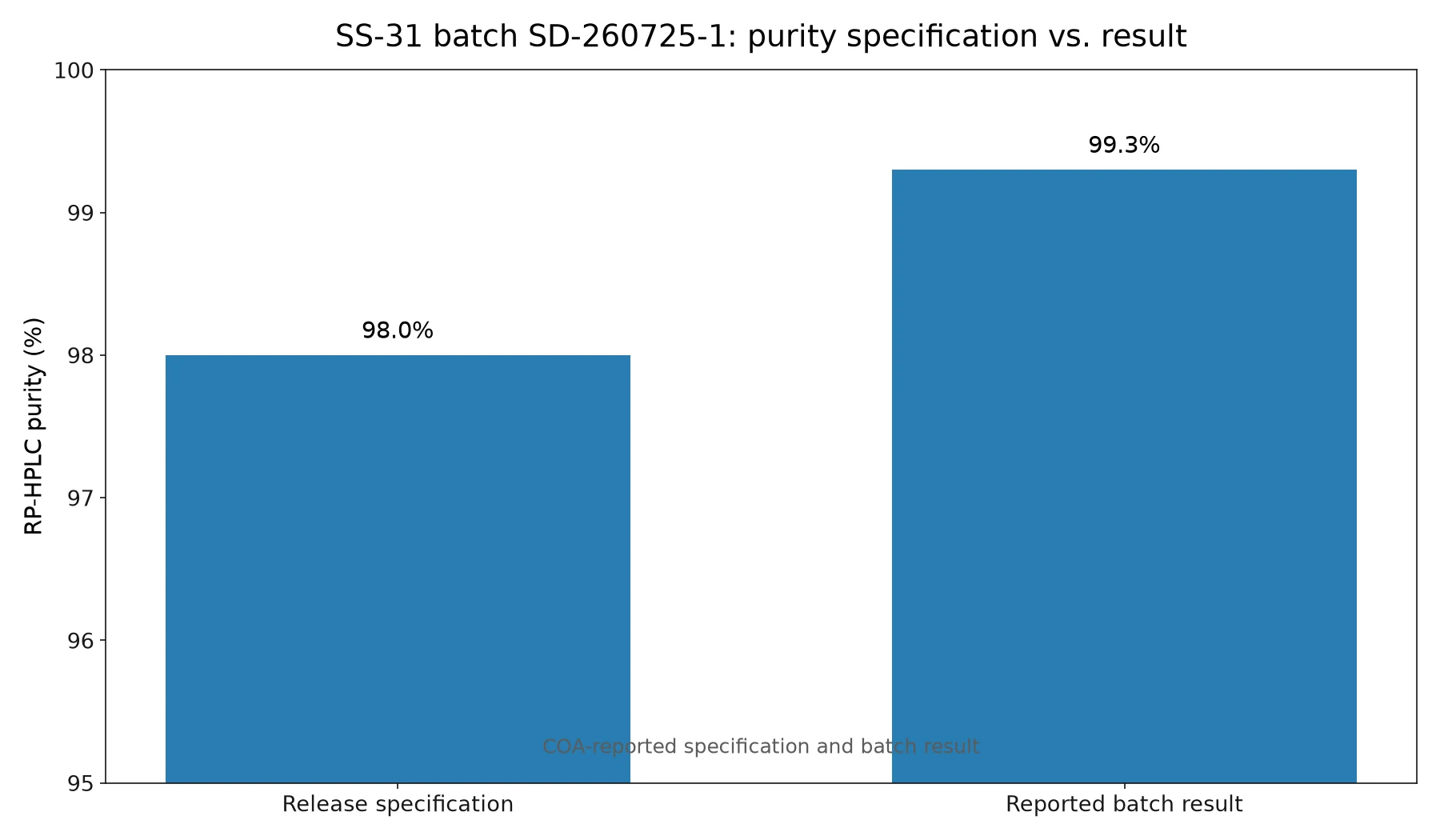
| Specification | ≥98.0% | The predetermined acceptance criterion |
| Result | 99.3% | The value measured for the batch |
“99.3% chromatographic purity by RP-HPLC” identifies both the measured result and the technique. “99.3%” alone does not identify what was measured. ICH Q6A describes a specification as a list of tests, references to analytical procedures, and acceptance criteria. Although Q6A applies to pharmaceutical substances and products rather than research-use-only materials, its test–method–criterion framework is a useful analytical reference point.
3. Read peptide identity separately from purity
Peptide identity asks whether the analyzed material is consistent with the expected molecular species. Mass spectrometry commonly supports this assessment by comparing observed ions or a deconvoluted mass with the theoretical molecular mass calculated from the sequence and defined modifications.
Expected sequence and modifications → theoretical molecular mass → observed MS data → identity assessment
The following values are fictional and included only to show how expected and observed mass may be presented:
| Parameter | Illustrative entry |
|---|---|
| Calculated molecular mass | 1234.5 Da |
| Observed deconvoluted mass | 1234.4 Da |
| Technique | LC-MS |
| Interpretation | Consistent with the expected molecular species |
Electrospray ionization can produce multiple charge states, so a raw mass-to-charge (m/z) value should not automatically be read as the neutral molecular mass. Appropriate charge-state interpretation or deconvolution may be needed.
A whole-mass match also does not confirm every structural feature. Isobaric sequence differences, stereochemistry, positional isomers, or specific modifications may require LC-MS/MS, peptide mapping, chiral analysis, NMR, or another orthogonal technique. See the peptide and analytical glossary for concise definitions.
4. Interpret RP-HPLC peptide purity in context
A peptide COA commonly reports chromatographic purity by reversed-phase high-performance liquid chromatography (RP-HPLC) or UPLC. A result such as “RP-HPLC purity: 99.3%” usually describes the proportion of integrated detector response assigned to the principal peak under the stated method.
It does not automatically mean that 99.3% of all physical material in the vial is peptide by mass. Review the batch result together with the method, specification, detector conditions, integration approach, and chromatogram when supplied. Different peptide-related impurities may produce different detector responses; relative response factors can matter when accurate impurity quantitation is required.
For a deeper method-focused explanation, read why 99% HPLC does not tell the whole story.
5. Peptide content is not the same as HPLC purity
Chromatographic purity describes relative detector response among separated components under a defined method. Quantitative peptide content describes the amount or mass fraction of the target peptide in the supplied material using a suitable quantitative framework.
Depending on the material and analytical purpose, quantitative value assignment may use amino-acid analysis, quantitative NMR, an assay against a sufficiently characterized reference material, mass balance, or another validated quantitative method. Counterions, water, residual solvents, and other non-peptide components can contribute to total material mass without appearing as equivalent peptide signal in an HPLC area calculation.
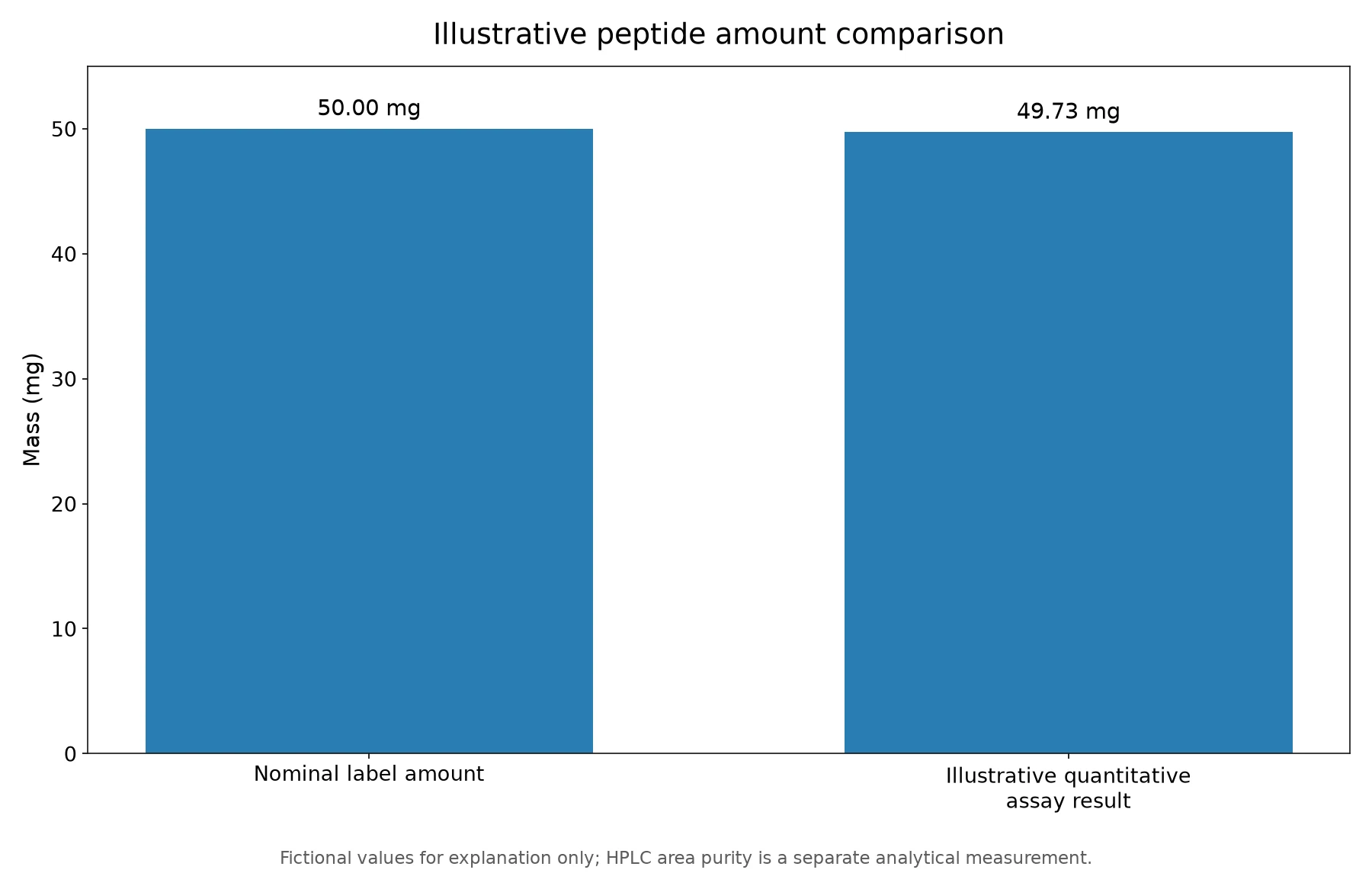
Researchers should therefore not calculate peptide mass directly from an HPLC area-purity percentage unless the documented analytical framework specifically supports that calculation.
6. Check the counterion or salt information
Synthetic peptides may be supplied with counterions such as acetate or trifluoroacetate (TFA). A counterion is not the same analytical class as a peptide-related chromatographic impurity, but it affects the composition and total mass of the peptide salt.
If counterion content is reported, identify the counterion, result, unit, and analytical method, then assess whether it is relevant to the specification or planned experiment. The acetate versus TFA peptide salts guide explains this distinction in more detail.
7. Review water and volatile content
Lyophilized material is not necessarily water-free. Water contributes to total mass but is not represented in the same way as peptide-associated peaks in an RP-HPLC area-purity calculation.
Karl Fischer titration is a water-specific quantitative technique. Loss on drying or thermogravimetric analysis can report mass loss or thermal events, but those results are not automatically equivalent to water content. “99% HPLC purity” and a water-content result are separate analytical findings.
8. Interpret additional tests according to their purpose
Some peptide COAs include additional attributes. Their relevance depends on the material, process, specification, and intended laboratory application.
- Residual solvents: GC or GC-MS may be used when process solvents are relevant.
- Elemental impurities: ICP-MS or ICP-OES may be used to evaluate trace elemental composition.
- Microbiological attributes: microbial tests address questions that chemical purity methods do not.
- Endotoxin: an endotoxin claim requires an appropriate endotoxin-specific assay.
A high RP-HPLC result does not establish sterility, bioburden, or endotoxin status. Those attributes should be stated only when the corresponding test was performed.
9. Look beyond the word “PASS”
“Purity: PASS” provides less information than “RP-HPLC — specification: ≥98.0% — result: 99.3%.” Likewise, “Identity: PASS” becomes more useful when paired with the method and, where relevant, theoretical and observed molecular-mass data.
A pass/fail statement communicates an acceptance decision. It does not, by itself, disclose the analytical observation behind that decision.
10. Review chromatograms and mass spectra with the method
Supporting chromatograms and spectra add context, but they must be interpreted in relation to the analytical method.
What should you check on an HPLC chromatogram?
Check the sample or lot identifier, method reference, principal and secondary peaks, retention times, reported area percentages, integration context, and detector details where available. A visually clean trace cannot be interpreted independently of separation, detection, and integration parameters.
What should you check on a mass spectrum?
Check the sample identity, expected molecular mass, detected ions or deconvoluted mass, technique, and whether the data support the specific identity conclusion. Chromatography, mass spectrometry, peptide mapping, and quantitative methods provide complementary—not interchangeable—evidence.
11. COA details that warrant closer review
- No identifiable batch or lot number.
- The certificate cannot be linked to the supplied material.
- Specifications appear without lot-specific results.
- Analytical methods or units are missing.
- “PASS” appears without sufficient context.
- HPLC area purity is treated as quantitative peptide content.
- Identity is inferred only from chromatographic purity or retention time.
- A mass-spectrometry identity claim lacks relevant expected and observed mass information.
- Microbiological or endotoxin attributes are implied without corresponding tests.
- Supporting analytical records cannot be traced to the stated batch.
These observations do not by themselves prove that a material is unsuitable. They indicate that more analytical information may be needed before the COA can answer the research question.
12. A practical peptide COA review framework
| Review step | Question |
|---|---|
| 1. Material | Which peptide and chemical form are described? |
| 2. Lot | Does the COA match the supplied batch? |
| 3. Test | Which analytical attribute was evaluated? |
| 4. Method | How was that attribute measured? |
| 5. Specification | Which acceptance criterion was applied? |
| 6. Result | What was measured for this batch? |
| 7. Interpretation | Does the result support the stated conclusion? |
| 8. Supporting data | Are relevant chromatograms, spectra, or records available? |
Material → Lot → Test → Method → Specification → Result → Interpretation → Supporting data
This order is more informative than beginning and ending with the headline purity percentage. Use it when reviewing an individual batch COA, then compare the methods with the broader Analytical Methods research library.
Conclusion: a COA maps the analytical evidence
A useful peptide COA connects a defined material and batch with specific analytical measurements. It separates identity from purity, purity from quantitative peptide content, specifications from actual batch results, and chemical analysis from microbiological testing.
The better question is not “Is there a COA?” but “What does this COA support for the batch under review?” That distinction helps prevent unsupported analytical assumptions from becoming variables in laboratory research.
Frequently asked questions about peptide COAs
What is a COA for peptides?
A peptide Certificate of Analysis is a lot-specific document summarizing the identity of the material, tests performed, analytical methods, specifications, and results reported for that batch.
How do you verify a peptide COA?
Match the peptide name and lot to the supplied material, identify each test and method, compare specifications with actual results, review supporting chromatograms or spectra, and confirm that every conclusion is limited to the evidence reported.
Is a 99% HPLC result the same as 99% peptide content?
No. HPLC area purity is a chromatographic detector-response measurement. It does not automatically account for water, counterions, residual solvents, or other components contributing to total material mass.
Can HPLC confirm peptide identity?
Not by itself in most cases. HPLC provides retention and separation information; mass spectrometry or another suitable orthogonal identity method provides independent molecular evidence.
Does a COA guarantee that a peptide suits every experiment?
No. A COA reports defined tests and results. Researchers must decide whether the methods, attributes, specifications, handling conditions, and controls are appropriate for their particular in-vitro study.
Research use only
Vector E Lab materials are supplied strictly for laboratory research and analytical examination. They are not intended for clinical use, diagnosis, treatment, disease prevention, or administration to humans or animals. Review the authoritative Research-Use Disclaimer and the research peptide FAQ.
Analytical Standards Referenced by Vector E Lab
- 1.ICH Q6A: Specifications—Test Procedures and Acceptance Criteria — International Council for Harmonisation
- 2.ICH Q2(R2): Validation of Analytical Procedures — International Council for Harmonisation
- 3.USP General Chapter <621> Chromatography — United States Pharmacopeia
- 4.Certificate of Analysis library — Vector E Lab
Related products, documentation, and methods
Products and batch documentation
Analytical method guides
- RP-HPLC purity standards guideHow chromatographic purity is determined and what a ≥ 99.0% release limit does and does not describe.
- Mass spectrometry and analytical testing guideLC-MS identity confirmation, orthogonal testing layers, and how to read the analytical parameters on a Certificate of Analysis.
Research library
Regulatory and compendial references
- USP <621> Chromatography — United States Pharmacopeia
- ICH Q2(R2) Validation of Analytical Procedures — ICH
Reviewing materials for your next study?
Every Vector E Lab compound ships with lot-specific analytical documentation, including HPLC and mass spectrometry data. Products are supplied strictly for in-vitro research use.
Related reading
- Technical GuideWhat Are Research Peptides? A Technical Guide to Peptide Identity, Purity & QualityResearch peptides are peptide materials supplied for laboratory research rather than clinical use. This technical guide explains peptide ide…
- Technical GuideHow to Evaluate Peptide Purity, Identity, Microbial Quality, and Trace ContaminantsA technical guide to reading research peptide analytical data: RP-HPLC purity, LC-MS identity confirmation, USP <61>/<62>/<71> microbial sta…
- Analytical GuidePeptide-Related Impurities: Formation, Detection and InterpretationA researcher's guide to sequence variants, oxidation, stereochemical impurities, co-elution, and the complementary methods used to investiga…