
Peptide Science
Salicylic Acid–Peptide Compatibility: Stability and Formulation Considerations
A technical review of formulation compatibility and peptide stability under acidic conditions: pH-driven degradation pathways, chelation effects on copper peptides, and the RP-HPLC and LC-MS methods used to verify compatibility in vitro.
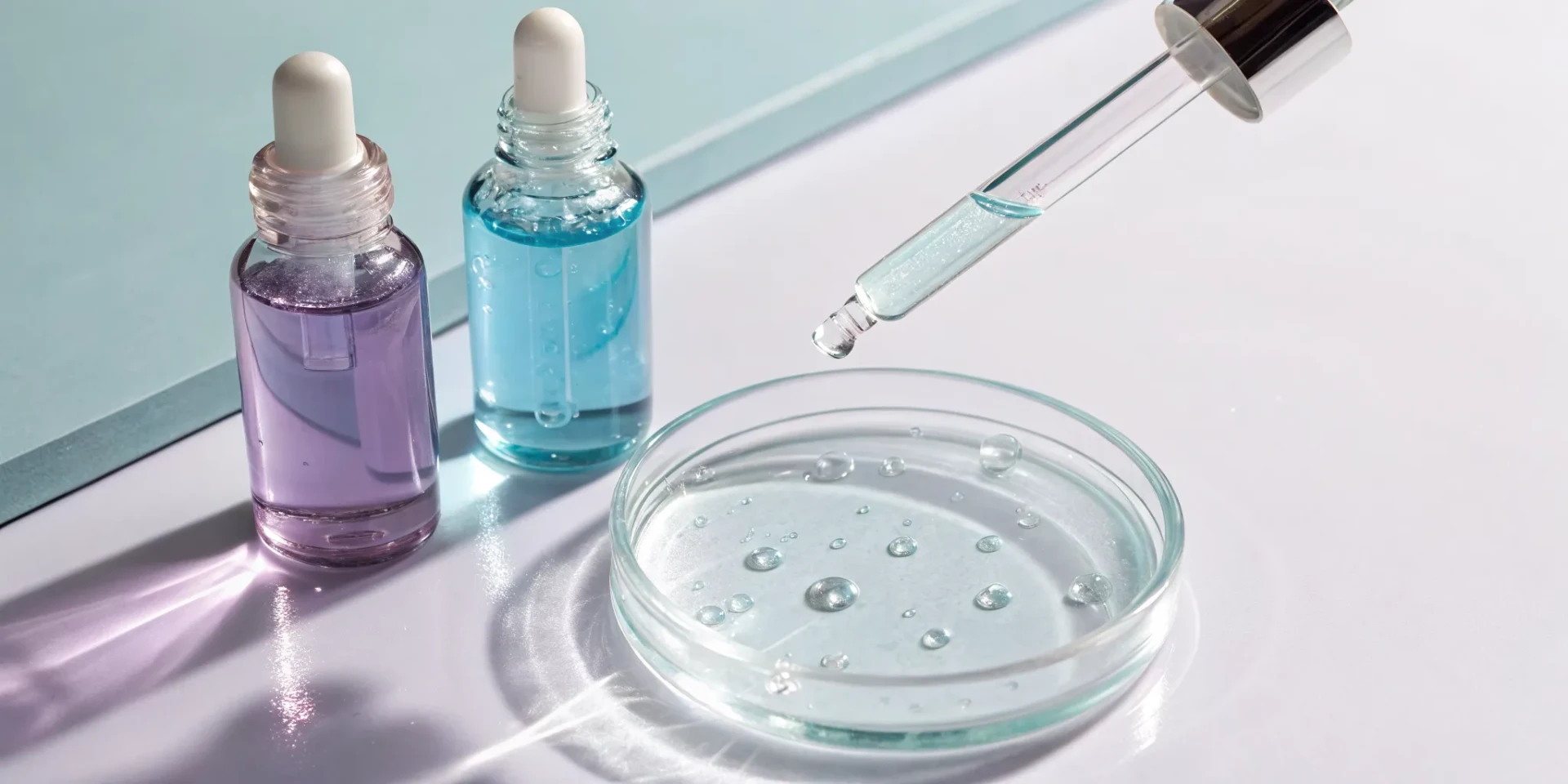
Salicylic acid (2-hydroxybenzoic acid) and synthetic peptides are frequently combined in the same experimental or formulation matrix, yet they occupy very different chemical stability envelopes. This article examines salicylic acid–peptide compatibility from an analytical and formulation standpoint: pH-dependent peptide stability, degradation pathways observed under acidic conditions, metal-complex considerations for copper peptides, and the orthogonal methods used to monitor compatibility in vitro. All content is written for qualified laboratory personnel and applies strictly to Research Use Only (RUO) materials.
Key Analytical Takeaways
- pH is the controlling variable. Salicylic acid has a pKa near 3.0, so working solutions containing it are typically acidic. Peptide backbone and side-chain stability must be assessed at that measured pH, not at the pH of the peptide stock alone.
- Compatibility is peptide-specific. Sequence composition — particularly Asp-Pro, Asn, Gln, Met, Trp, and Cys residues — determines which acid-catalyzed degradation pathways dominate. No single compatibility statement applies across a catalog.
- Compatibility must be measured, not assumed. Forced-degradation and time-point sampling with RP-HPLC purity tracking and LC-MS identity confirmation are the practical basis for any compatibility conclusion.
Chemical Profile of Salicylic Acid in Laboratory Matrices
Salicylic acid is a beta hydroxy acid with a carboxyl group ortho to a phenolic hydroxyl. That arrangement gives it low aqueous solubility, appreciable solubility in ethanol and propylene glycol, and a strong tendency to lower the pH of unbuffered aqueous systems. It is also a bidentate ligand: the ionized carboxylate and phenolate can chelate divalent and trivalent metal cations, which is directly relevant to metal-complexed peptides.
Solvent and Buffer Behavior
Because salicylic acid is only sparingly water soluble, laboratory preparations commonly rely on co-solvents or buffered systems. Any co-solvent introduced to dissolve salicylic acid becomes part of the peptide's storage environment and must be evaluated for its own effect on peptide conformation, aggregation, and adsorption to container surfaces.
How Acidic Conditions Affect Peptide Integrity
Peptides are not uniformly acid-labile, but several well-characterized degradation routes are accelerated at low pH. When a peptide is held in a salicylic acid–containing matrix, these are the pathways to monitor:
- Backbone hydrolysis: acid-catalyzed cleavage, with Asp-Pro and Asp-Xaa bonds among the most susceptible motifs.
- Deamidation and succinimide chemistry: Asn and Gln residues follow pH-dependent pathways; acidic conditions shift the relative rate of direct hydrolysis versus cyclic imide formation.
- Oxidation: Met, Cys, and Trp residues remain oxidation-sensitive, and trace metals carried into the system can catalyze that oxidation.
- Aggregation and precipitation: a shift in pH toward a peptide's isoelectric point reduces net charge and colloidal stability, which can produce visible precipitate or a loss of recovered mass without any change in the chromatographic purity of what remains in solution.
Why Purity Alone Can Mislead
An RP-HPLC purity value describes the composition of what is dissolved and injected. If part of the peptide has precipitated, purity can appear unchanged while total recovered peptide has fallen. Compatibility studies should therefore track both area-percent purity and absolute recovered amount against a reference standard.
Copper Peptides and Chelation Competition
Copper-complexed peptides such as GHK-Cu present a specific compatibility question. Their defined activity in published research depends on the intact copper complex, and salicylic acid is itself a metal-binding ligand. In a shared matrix, competition for the metal center is a plausible mechanism of change, and acidic pH additionally favors protonation of the peptide's coordinating nitrogen donors. Complex integrity should be evaluated directly — for example by UV-Vis absorbance of the copper d–d band, LC-MS of the complexed and free species, and elemental analysis where quantitation is required — rather than inferred from peptide purity alone. Related background is covered in our GHK-Cu research overview.
Designing a Compatibility Study
A defensible compatibility assessment follows the same logic as a forced-degradation study:
- Define the matrix. Record the salicylic acid concentration, co-solvent, buffer species and molarity, measured pH, container material, and headspace.
- Establish a t = 0 baseline. Characterize the peptide alone and the peptide in matrix at time zero using RP-HPLC and LC-MS.
- Include controls. Run the peptide in buffer at matched pH without salicylic acid to separate pH effects from salicylic-acid-specific effects.
- Sample across time and temperature. Accelerated conditions surface degradants faster; real-time conditions establish practical hold times.
- Confirm mass balance. Reconcile the parent peak, degradant peaks, and total recovered peptide.
Analytical Methods Used
| Question | Method | What it reports |
|---|---|---|
| Has purity changed? | RP-HPLC (UV) | Area-percent parent peak and emerging degradant peaks |
| Is the peptide still the intended molecule? | LC-MS | Observed monoisotopic or average mass versus theoretical |
| What are the degradants? | LC-MS/MS | Fragmentation evidence for cleavage, deamidation, oxidation |
| Is the metal complex intact? | UV-Vis, ICP-OES | Complex-associated absorbance; total elemental copper |
| Has material been lost from solution? | Quantitative HPLC vs. standard | Absolute recovered peptide, independent of purity |
Method expectations for these techniques are described in more depth in our peptide analytical testing guide.
Formulation Strategies When Co-Presence Is Required
Where an experimental design requires both components, several strategies reduce the risk of confounded results:
- Temporal separation: prepare and apply the two systems as separate steps rather than as a premixed solution, so exposure time in the acidic matrix is minimized and defined.
- Buffer control: hold the combined system at a pH characterized as acceptable for the specific peptide, using a buffer of sufficient capacity that the salicylic acid does not drive the pH.
- Prepare fresh: treat combined solutions as short-hold preparations with a documented, data-supported use window rather than as stored stocks.
- Reduce catalytic load: use low-metal reagents and appropriate container materials to limit trace-metal-catalyzed oxidation.
- Lyophilized storage: keep peptide material lyophilized and cold until the study requires reconstitution; see our notes on reconstitution diluent quality.
Documentation That Supports Compatibility Work
Reproducible compatibility data depends on well-characterized starting material. Lot-specific Certificates of Analysis provide the RP-HPLC purity baseline, LC-MS identity confirmation, and microbiological and residual-solvent results needed to interpret any change observed during a study. Batch documents for Vector E Lab materials are available through the COA library, and catalog specifications are listed on the research peptide catalog.
Frequently Asked Questions
Are salicylic acid and peptides chemically compatible?
Compatibility is peptide-specific and matrix-specific. Salicylic acid lowers the pH of unbuffered aqueous systems and can chelate metal ions, both of which can accelerate peptide degradation pathways. Compatibility should be established experimentally for each peptide, concentration, and matrix rather than assumed.
What pH range is appropriate for peptides in an acidic matrix?
There is no universal range. Acid-catalyzed hydrolysis, deamidation rate, and isoelectric behavior all vary with sequence, so the acceptable pH window must be determined from stability data for the specific peptide.
Which analytical methods detect salicylic acid–induced peptide degradation?
RP-HPLC tracks purity and emerging degradant peaks, LC-MS confirms molecular identity, LC-MS/MS characterizes degradants, and quantitative HPLC against a reference standard detects material lost to precipitation.
Does salicylic acid affect copper peptide complexes?
Salicylic acid is a metal-binding ligand, so competition for the copper center is a plausible mechanism of change. Complex integrity should be assessed directly using UV-Vis, LC-MS, and elemental analysis rather than inferred from peptide purity.
Should combined solutions be stored?
Combined acidic solutions are best treated as short-hold preparations with a documented use window supported by stability data, with peptide material otherwise held lyophilized and cold.
Research Use Only
All materials and information referenced here are supplied strictly for in-vitro laboratory research, analytical testing, and formulation development by qualified personnel. Nothing on this page describes cosmetic, therapeutic, diagnostic, or personal use, and no product supplied by Vector E Lab is intended for human or veterinary administration.
Analytical Standards Referenced by Vector E Lab
- 1.Vector E Lab lot-specific Certificates of Analysis — RP-HPLC purity (≥98.0% specification), LC-MS identity confirmation, and batch microbiological results — Vector E Lab COA Library (first-party documentation)
- 2.USP <621> Chromatography — system suitability and reporting requirements underlying reverse-phase HPLC purity determinations — United States Pharmacopeia (USP–NF)
- 3.USP <736> Mass Spectrometry — identity confirmation by molecular mass, consistent with the LC-MS data reported on batch COAs — United States Pharmacopeia (USP–NF)
Related products, documentation, and methods
Products and batch documentation
Analytical method guides
- How to read a peptide Certificate of AnalysisA lot-by-lot framework for reviewing identity, RP-HPLC purity, peptide content, specifications, results, and supporting analytical data.
- RP-HPLC purity standards guideHow chromatographic purity is determined and what a ≥ 99.0% release limit does and does not describe.
- Mass spectrometry and analytical testing guideLC-MS identity confirmation, orthogonal testing layers, and how to read the analytical parameters on a Certificate of Analysis.
Research library
Regulatory and compendial references
- ICH Q1A(R2) Stability Testing of New Drug Substances — ICH
- USP <621> Chromatography — United States Pharmacopeia
Reviewing materials for your next study?
Every Vector E Lab compound ships with lot-specific analytical documentation, including HPLC and mass spectrometry data. Products are supplied strictly for in-vitro research use.
Related reading
- Peptide ScienceKPV Peptide: Structure, Properties, Mechanism, Research, and Future OutlookKPV is a three-amino-acid research peptide derived from α-MSH. This guide explains its structure, proposed mechanism, current preclinical re…
- Peptide ScienceTB-500 Peptide: Structure, Properties, Mechanism, Research, and Future OutlookTB-500 is an acetylated seven-amino-acid research peptide related to the actin-binding region of thymosin beta-4. This guide explains its st…
- Peptide ScienceWolverine Stack: A Research-Focused Review of BPC-157 and TB-500The Wolverine Stack is an informal research term for BPC-157 and TB-500-related materials. This review examines the evidence behind each pep…