
Research
Solid-Phase vs. Liquid-Phase Peptide Synthesis 2026
This article explores the key differences between solid-phase and liquid-phase peptide synthesis, highlighting their unique advantages and applicability in peptide manufacturing. It also discusses emerging techniques and the future of peptide therapeutics in various medical fields.
Abstract
Due to advancements in molecular design, increased clinical success, and a growing demand for focused medicines, peptide therapeutics have become a rapidly expanding class of pharmacological drugs. With the growth of peptide-based therapies in metabolic disorders, oncology, infectious diseases, and various other treatment fields, the approach to manufacturing has emerged as a crucial factor influencing cost, scalability, product quality, and regulatory compliance. Solid-phase peptide synthesis (SPPS) and liquid-phase peptide synthesis (LPPS), the two primary synthetic techniques, each have special advantages and disadvantages that influence their suitability at different stages of product development and commercial production. This review thoroughly evaluates the current state of SPPS and LPPS, emphasizing technical principles, production economics, scalability, purification needs, sustainability aspects, and regulatory issues. Emerging technologies, including hybrid SPPS/LPPS manufacturing techniques and continuous-flow peptide synthesis, are being explored as potential methods to address the growing intricacy and scale required for producing therapeutic peptides. Current industrial applications, such as the production of tirzepatide, show how hybrid methods can combine the adaptability of SPPS with the scalability benefits of solution-phase processing for commercial peptide manufacturing support. Existing data indicates that SPPS remains the primary platform for research, clinical development, and the synthesis of structurally complex peptides, while LPPS still provides notable advantages for certain large-scale manufacturing processes involving short peptides and peptide intermediates. In general, no single synthesis platform is ideally suited for all situations; effective process selection relies on peptide intricacy, desired purity, production volume, financial limitations, and regulatory criteria. A practical decision framework is provided to facilitate the selection of evidence-based manufacturing strategies in modern peptide production.
Keywords: peptide therapeutics; peptide manufacturing; solid-phase peptide synthesis (SPPS); liquid-phase peptide synthesis (LPPS); hybrid synthesis; continuous-flow peptide synthesis; sustainability; process economics; pharmaceutical production; peptide active pharmaceutical ingredients (APIs); ICH Q11
1. Introduction
Peptide therapeutics are one of the fastest-growing areas in the pharmaceutical pipeline. Market projections vary among reporting agencies, yet peptide therapeutics continue to demonstrate strong commercial growth (Lau & Dunn, 2018; Muttenthaler et al., 2021). Peptides exist in a chemical realm that small molecules struggle to penetrate—able to interfere with protein–protein interactions, imitate natural signaling molecules, and attain selective profiles that minimize off-target toxicity (Muttenthaler et al., 2021). The clinical efficacy of tirzepatide and semaglutide for type 2 diabetes and obesity has demonstrated that peptide APIs can achieve blockbuster commercial levels, significantly boosting global demand for large-scale peptide manufacturing (Muttenthaler et al., 2021; Martin et al., 2020).
At the centre of this manufacturing dilemma lies a question that is both technical and financial: which synthesis platform most effectively supports a specific peptide project? Although the two most popular approaches—SPPS and LPPS—have both advanced significantly over the past 30 years, their benefits still depend on the situation. SPPS, initially introduced by Merrifield (1963) and later enhanced via Fmoc chemistry, has become the leading method for research and initial production due to its suitability for automation and capacity to enable rapid peptide construction (Behrendt et al., 2016). LPPS remains an important manufacturing method for short peptides and peptide intermediates, particularly in large-scale production where efficient isolation, purification through crystallization, and reduced reliance on solid supports can improve economics (Isidro-Llobet et al., 2019; Martin et al., 2020).
Peptide production decisions are increasingly being influenced by sustainability considerations, particularly due to concerns about solvent consumption and process mass intensity (Isidro-Llobet et al., 2019). Green chemistry initiatives are urging manufacturers to reevaluate their choice of solvents in SPPS (Wegner et al., 2021). Convergent synthetic techniques that combine SPPS-derived segments with solution-phase coupling are increasingly being used for long and structurally complex peptides (Albericio et al., 1997; de la Torre & Albericio, 2022). Continuous-flow peptide synthesis has emerged as a viable alternative for conventional batch processing, providing reduced reaction times, better process control, and increased throughput for specific peptide manufacturing uses (Coin et al., 2007; Mijalis et al., 2017). In light of this, a comprehensive, evidence-based evaluation of the two primary synthesis platforms—examined from the perspective of cost-effectiveness— addresses a distinct requirement for both purchasing decision-makers and industrial practitioners.
This review thoroughly assesses the comparative benefits and limitations of SPPS and LPPS in contemporary peptide production, highlighting aspects that affect cost-effectiveness, scalability, sustainability, and process selection.
2. Fundamentals of Peptide Synthesis Platforms
2.1 Solid-Phase Peptide Synthesis
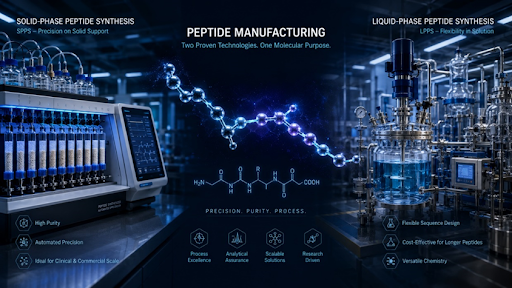
In SPPS, the desired sequence's C-terminal amino acid is first attached to a non-soluble polymer resin, and the chain is then gradually extended towards the N-terminus. Every elongation cycle includes the removal of the temporary alpha-amine protecting group, followed by a washing phase, the coupling of the subsequent activated amino acid, and a final washing step to eliminate excess reagents (Amblard et al., 2006). Fmoc chemistry has emerged as the primary protection strategy in modern SPPS due to its compatibility with various side-chain protecting groups and its elimination of hydrogen fluoride needed for final cleavage in Boc-based methods (Behrendt et al., 2016).
The primary advantage of SPPS is how simple coupling operations are. Reactions are accelerated by excess reagents, and unreacted materials are simply rinsed out rather than chemically separated. This design allows automation on commercial synthesizers capable of executing multiple parallel sequences at the same time (Mäde et al., 2014). Contemporary microwave-assisted and automated peptide synthesizers have significantly reduced the length of synthesis cycles and increased productivity for typical peptide production.
After synthesis, purification has the biggest financial impact on SPPS. Deletion sequences, racemized residues, and partially deprotected side chains are common components of crude SPPS products that require purification using preparative reverse-phase high-performance liquid chromatography (RP-HPLC). Purification often constitutes a significant factor in the total cost of manufacturing (Behrendt et al., 2016; Martin et al., 2020). At the industrial level, the use of solvents—DMF, acetonitrile, and dichloromethane are the primary solvents—raising costs and environmental concerns (Isidro-Llobet et al., 2019)
2.2 Liquid-Phase Peptide Synthesis
LPPS carries out every coupling and deprotection step in a homogeneous solution. Before proceeding to the next stage, the growing peptide intermediate is separated by precipitation, crystallization, or chromatographic methods after each reaction. The need for intermediate isolation raises the intricacy of the process and may decrease operational efficiency as the length of the peptide increases (Verlander, 2007). However, LPPS is still appealing for short peptides and peptide intermediates, particularly when crystallization purification may be used to obtain high-purity intermediates without requiring extensive chromatography steps.
When large-scale solution-phase processing and economical crystallization-based purification can be used, liquid-phase peptide synthesis remains an essential commercial technique for generating short peptides and peptide intermediates (Verlander, 2007; Martin et al. 2020). At extensive manufacturing levels, LPPS prevents resin swelling and solid-phase mass-transfer limitations that can hinder process scale-up in SPPS (Isidro-Llobet et al., 2019; Martin et al., 2020). Through efficient solution-phase processing and reduced reliance on chromatographic purification, LPPS can offer economic advantages for the large-scale production of short peptide APIs.
2.3 Emerging Technologies and Hybrid Synthesis Strategies
The conventional distinction of solid-phase peptide synthesis (SPPS) and liquid-phase peptide synthesis (LPPS) is progressively being enhanced by new technologies focused on improving efficiency, sustainability, and scalability. Recent advancements in peptide manufacturing involve automated chemputation systems, continuous-flow peptide synthesis, and the use of green chemistry methods to reduce waste output and enhance process efficiency. These advancements are intended to address significant shortcomings of conventional peptide synthesis, including high solvent consumption, lengthy synthesis periods, and challenges in producing structurally complex peptides (Cai et al., 2025).
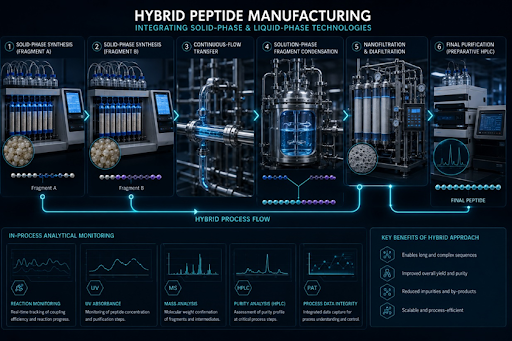
Among these advancements, hybrid synthesis methods have attracted considerable interest as effective approaches for producing longer and more intricate peptide therapeutics. Hybrid methods often merge the rapid fragment assembly functions of SPPS with solution-phase fragment condensation techniques, enabling producers to lessen the overall effects of incomplete coupling reactions linked to extensive linear syntheses. Utilizing the complementary advantages of both platforms, hybrid approaches can enhance synthetic efficiency, facilitate scale-up, and provide access to peptide structures that might be challenging to acquire through either SPPS or LPPS alone (Cai et al., 2025).
2.3.1 Case Study: Hybrid SPPS/LPPS Manufacturing of Tirzepatide
An important industrial use of hybrid peptide synthesis is the kilogram-scale GMP production of tirzepatide, with SPPS utilized to produce peptide fragments that were later combined through LPPS processes. To increase yield, purity, and process reliability, the approach combined continuous production technology, real-time analytical monitoring, and intermediate purification by nanofiltration. This hybrid SPPS/LPPS approach was designed to tackle the manufacturing difficulties linked to complex therapeutic peptides, showcasing how the combined benefits of solid-phase and solution-phase synthesis can be united to facilitate scalable commercial production (Frederick et al., 2021).
The concept of hybridization has expanded beyond manufacturing to include peptide therapeutic research. Peptide–drug conjugates and peptide–small molecule hybrids merge the targeting precision of peptides with the pharmacological benefits of small molecules, improving metabolic stability, cellular absorption, and therapeutic effectiveness. These adaptable systems are increasingly being investigated in infectious diseases, oncology, and metabolic disorders, highlighting the growing importance of hybrid technologies in peptide synthesis and advanced drug development (Dean et al., 2024; Wu et al., 2021).
Collectively, these advancements demonstrate the shift in peptide synthesis from the conventional SPPS-versus-LPPS model to combined manufacturing approaches that emphasize efficiency, sustainability, and molecular intricacy. With the growing complexity and market demand for therapeutic peptides, hybrid and continuous manufacturing technologies are anticipated to become increasingly crucial in future peptide production.
3. Comparative Cost-Efficiency Analysis
3.1 Raw Material Costs
Cost for raw materials in SPPS include resin, Fmoc-protected amino acids featuring orthogonal side-chain protection, coupling agents (usually HATU and HBTU), and bases (piperidine or morpholine used for deprotection). Coupling reagents account for a significant portion of raw material costs in SPPS, particularly for complex sequences requiring several coupling cycles. The capacity for resin loading and the selection of resin play a crucial role in the use of reagents and the overall efficiency of the process in SPPS (Behrendt et al., 2016).
Because protecting group chemistry is simplified in LPPS—using a single protecting group method rather than the numerous orthogonal protections required for SPPS—the cost of raw materials is typically lower per mole of peptide bonds formed. Compared to SPPS, LPPS can achieve superior atom economy and may require fewer protected intermediates for short peptide sequences. However, this advantage decreases rapidly as chain lengthens and additional isolation steps proliferate (Verlander, 2007).
3.2 Labor Requirements and Process Throughput
Automation has greatly enhanced the efficiency of SPPS by minimizing manual handling and allowing for unattended execution of repetitive coupling, deprotection, and washing processes. Contemporary automated synthesizers are capable of generating various peptide sequences with minimal operator involvement, rendering SPPS especially appealing for research and clinical manufacturing (Mäde et al., 2014).
In contrast, as peptide length increases, LPPS usually requires the isolation and purification of intermediates following each synthetic step, increasing process complexity and labor requirements. While LPPS continues to be beneficial for some short peptides and large-scale industrial uses, the overall effort of intermediate processing frequently restricts its feasibility for longer sequences (Verlander, 2007; Amblard et al., 2006).
3.3 Purification Costs
It is widely accepted that purification has a significant role in the overall cost of producing peptides. Preparative RP-HPLC setups necessitate considerable financial investment, utilize large quantities of acetonitrile and water, and create throughput limitations that scale non-linearly with the batch size. It is frequently considered as one of the most expensive and resource-intensive procedures in the synthesis of peptides (Henninot et al., 2018).
LPPS, suitable for crystallization, bypasses this HPLC challenge. A well-designed crystallization process can reduce the need for chromatographic purification and yield extremely pure peptide intermediates. However, crystallization parameters are sequence-specific and must be determined empirically; this development expenditure is only justified for products with large volumes and extended lifespans (Verlander, 2007)
3.4 Manufacturing Scale and Economic Considerations
The economic benefits of SPPS and LPPS differ depending on the scale of production and the complexity of the peptides. Because of its automation, versatility, and speed at producing different peptide sequences, SPPS remains the top platform for peptide research, discovery, and large-scale production. Conversely, LPPS may provide benefits for specific short peptides produced in large quantities, especially when crystallization-based purification is utilized to lower downstream processing expenses (Verlander, 2007; Martin et al., 2020).
In order to improve scalability, product quality, and overall process efficiency, more manufacturers are investigating hybrid synthetic approaches and cutting-edge process technologies that combine the strengths of solid-phase and liquid-phase procedures (Hartrampf et al., 2020)
Table 1 summarizes the main factors that distinguish SPPS and LPPS in technological, economic, and regulatory domains.
4. Comparative Summary
Table 1. Comparative overview of SPPS and LPPS (2026).
Parameter | Solid-Phase Peptide Synthesis (SPPS) | Liquid-Phase Peptide Synthesis (LPPS) |
Principle | Peptide is formed on a solid resin. | Peptide is formed in a liquid solution. |
Optimal Chain Length | Typically favored for peptides that are medium to long in length and structurally intricate. | Typically favored for shorter peptides and peptide intermediates. |
Automation | Fast, and highly automated. | Less automated due to the need for isolating each step |
Readiness | Strongly recognized for research, clinical applications, and intricate peptide synthesis. | Useful for selected large-scale short peptide synthesis. |
Purification Requirement | Typically requires RP-HPLC purification. | Crystallization or precipitation may be utilized if suitable. |
Scalability | Scalable, yet resin swelling and solvent usage may pose challenges. | Excellent scalability for short peptides in solution reactors. |
Solvent Consumption | High, because of continuous washing and purification. | Reduced in certain cases, yet still reliant on solvent. |
Approximate Cost/kg | Typically high, particularly for lengthy or intricate peptides. | Cheaper for short, high-volume peptides; expensive for longer peptides. |
Regulatory Precedent | Extensive ICH Q11 compliance pathway; Strong regulatory approval and widespread industrial adoption. | Accepted, but requires strong route and impurity control information. |
5. Decision Framework for Manufacturing Strategy
Sequence length, desired batch size, purity criteria, and product development phase are four important factors that must be systematically evaluated when selecting between SPPS, LPPS, and hybrid procedures. The subsequent framework summarizes existing evidence into useful criteria for making decisions.
SPPS continues to be the leading platform for peptide synthesis in discovery and early development due to its ability to automate, expedite, and offer great flexibility in assembling various peptide sequences, along with accommodating numerous structural modifications (Palomo, 2014; Winkler, 2020; Martin et al., 2020). Automation, combined with established ICH Q11 compliance routes and reliable purification processes, minimizes development risks and timelines. LPPS warrants serious evaluations for short peptides that are intended for commercial production in multi-kilogram to tonne-scale volumes, particularly where purification through crystallization is feasible and the synthesis can be lowered to fewer isolated intermediate steps.
Convergent synthetic approaches that merge SPPS-derived fragments with LPPS fragment condensation are often used to enhance synthetic efficiency and facilitate the construction of challenging targets, particularly for lengthy or structurally intricate peptides, that are difficult to assemble using only linear synthesis methods (Albericio et al., 1997; Barlos & Gatos, 1999). Fragment-based synthesis can mitigate the overall effects of incomplete coupling reactions and side reactions that lead to deletion sequences and epimerization when assembling lengthy peptide chains, thus enhancing the possibility of synthesizing intricate targets (Albericio et al., 1997; de la Torre & Albericio, 2022).
Environmental and regulatory factors are progressively becoming part of the decision-making process. Manufacturers who supply European markets need to evaluate new sustainability and regulatory initiatives pertaining to solvent selection, including potential restrictions on high-concern solvents like DMF. For innovative peptide APIs, it is essential to establish both SPPS and LPPS production pathways with adequate process comprehension, impurity management, and documentation to meet ICH Q11 requirements for drug-substance development and production (International Council for Harmonisation, 2012). From an industrial viewpoint, organizations with established SPPS might encounter fewer challenges to implementation than greenfield facilities, while new manufacturing sites may evaluate LPPS or hybrid platforms in addition to SPPS based on projected capital and operational costs.
6. Summary
The comparative landscape of peptide synthesis in 2026 does not indicate a single best manufacturing platform. SPPS remains the most popular approach for research, clinical development, and the synthesis of structurally complex peptides because of its suitability for automation, synthetic variety, and significant regulatory expertise. LPPS remains vital in the commercial production of short peptides and peptide intermediates, especially where large-scale solution-phase processing and crystallization purification can be effectively applied.
To address the growing complexity of therapeutic peptide targets, peptide manufacturers are increasingly using hybrid approaches that combine SPPS-generated fragments with solution-phase coupling techniques. Simultaneously, continuous-flow technology, solvent minimization initiatives, sustainability considerations, and process optimization techniques are transforming manufacturing decisions across the industry. The practical advantages of these integrated tactics are further demonstrated by industrial case studies. The development of hybrid SPPS/LPPS production methods for intricate peptide therapeutics like tirzepatide exemplifies how combining fragment-based synthesis, continuous processing techniques, and sophisticated purification methods can enhance scalability, process reliability, and manufacturing effectiveness. These examples suggest that future peptide manufacturing will increasingly depend on integrated process designs rather than solely relying on solid-phase or solution-phase methods.
Organizations may be better able to adjust to shifting manufacturing, regulatory, and economic conditions if they are able to evaluate and implement SPPS, LPPS, and hybrid strategies based on the particular requirements of products. Future advancements are anticipated to focus on improved purification technologies, stronger techno-economic models for process selection, better support materials, and more sustainable synthesis techniques. The logical selection of SPPS, LPPS, and hybrid manufacturing strategies for future peptide therapeutics would be aided by improved transparency and consistency in reporting manufacturing costs, process performance, and sustainability parameters.
References
|
|
|
|
|
|
|
|
|
|
|
|
|
|
|
|
|
|
|
|
|
|
|
Analytical Standards Referenced by Vector E Lab
- 1.USP <621> Chromatography — system suitability and reporting requirements underlying reverse-phase HPLC purity determinations — United States Pharmacopeia (USP–NF)
Related products, documentation, and methods
Analytical method guides
- How to read a peptide Certificate of AnalysisA lot-by-lot framework for reviewing identity, RP-HPLC purity, peptide content, specifications, results, and supporting analytical data.
- RP-HPLC purity standards guideHow chromatographic purity is determined and what a ≥ 99.0% release limit does and does not describe.
- Mass spectrometry and analytical testing guideLC-MS identity confirmation, orthogonal testing layers, and how to read the analytical parameters on a Certificate of Analysis.
Research library
Reviewing materials for your next study?
Every Vector E Lab compound ships with lot-specific analytical documentation, including HPLC and mass spectrometry data. Products are supplied strictly for in-vitro research use.
Related reading
- ResearchAcetate vs. TFA Peptide Salts: A Critical Review of Stability and Research ConsiderationsThis review examines how acetate and trifluoroacetate (TFA) salt forms can influence peptide stability, analytical characterization, reconst…
- ResearchA Researcher's Guide to Antimicrobial Peptides for SaleHow to qualify antimicrobial peptide material for laboratory research: purity and identity documentation, supplier and batch traceability cr…
- ResearchPeptide Research in 2026: Quality, Stability, and Emerging Scientific DevelopmentsAn analytical review of how peptide research is evolving through 2026: purity benchmarks, stability and storage data, lot documentation expe…