

Peptide Science
Tesamorelin: An Explicit Guide to Research Peptides for Studies on Visceral Fat
Introduction
Tesamorelin is a thoroughly researched synthetic peptide utilized in studies on metabolism and body composition. It is a stable form of GHRH, or growth hormone-releasing hormone. Tesamorelin has been investigated clinically for effects on visceral adipose tissue and GH-axis signaling in defined patient populations.
From research perspective, Tesamorelin is accurately characterized as a synthetic analog of growth hormone–releasing hormone that is FDA-approved for decreasing excess abdominal fat in HIV-infected adults diagnosed with lipodystrophy. Its extensive discussion should remain limited to the research setting and should not propose widespread therapeutic or wellness application outside its approved indication. (DrugBank, n.d.; U.S. Food and Drug Administration, 2019).
What Is Tesamorelin?
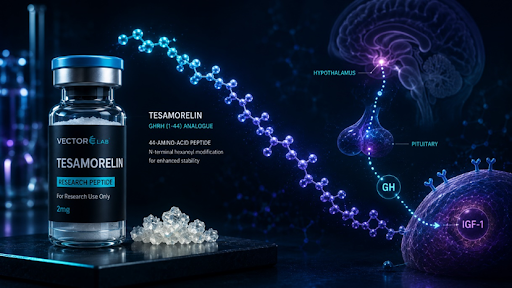
Tesamorelin consists of a peptide made up of 44 amino acids. Its structure is similar to that of normal human GHRH (1–44), but it has a trans-3-hexenoic acid group at the N-terminus to improve stability and extend action. The molecular formula is C221H366N72O67S1, and its molecular weight is roughly 5,135 Da (National Institute of Diabetes and Digestive and Kidney Diseases, 2018; U.S. Food and Drug Administration, 2019).
Tesamorelin can tolerate rapid degradation because to this modification, making it suitable for everyday use in research settings. It received initial approval from the FDA in 2010 with the brand name Egrifta (National Institute of Diabetes and Digestive and Kidney Diseases, 2018; U.S. Food and Drug Administration, 2019).
Why Researchers Study Tesamorelin?
Tesamorelin's unique action on the growth hormone (GH) axis and its clinical trials to reduce visceral adipose tissue (VAT) are the key reasons why researchers concentrate on it. Researchers also investigated its effects on abdominal fat that is difficult to address with diet and exercise alone, in contrast to conventional weight-loss strategies. Main research focuses consist of decreasing visceral fat, enhancing lipid profiles, alterations in lean body mass, muscle density, and overall metabolic health indicators, particularly in HIV-related lipodystrophy (Badran et al., 2026; Russo et al., 2024).
The majority of strong evidence originates from randomized controlled trials within the approved groups, with increasing interest regarding its possible uses for wider metabolic issues. This renders it a significant reference substance for studies on body composition and endocrine function (Clemmons et al., 2017).
How Tesamorelin May Work?
Tesamorelin does not function as a direct supplement for growth hormone. Rather, it functions higher up in the body's natural hormone pathway. Recent studies emphasize multiple interrelated mechanisms.
Pituitary Gland Stimulation: Tesamorelin binds to GHRH receptors on anterior pituitary somatotroph cells. Growth hormone is secreted in short, spontaneous bursts rather than continuously as a result of this relationship. This rhythmic pattern is thought to play a crucial role in preserving normal feedback control within the GH-IGF-1 axis.
IGF-1 Production: Growth hormone is secreted and flows to the liver, where it stimulates the production of insulin-like growth factor-1 (IGF-1). IGF-1 acts as a crucial mediator that facilitates numerous downstream effects related to fat metabolism and tissue upkeep (DrugBank, n.d.; National Institute of Diabetes and Digestive and Kidney Diseases, 2018).
Lipolysis and Visceral Fat Reduction: Hormone-sensitive lipase in adipocytes is activated by GH and IGF-1. Particularly in visceral (deep abdominal) fat, this mechanism breaks down stored triglycerides into free fatty acids. Research indicates this effect is more significant in visceral adipose tissue than in subcutaneous fat (Badran et al., 2026; Falutz et al., 2010).
Metabolic and Vascular Support: In addition to helping people lose weight, research suggests that tesamorelin may improve lipid profiles (such as lowering LDL cholesterol) and improve some aspects of metabolic health. Certain research examines its effect on inflammation indicators and general body composition in relevant groups (Adrian et al., 2018).
These mechanisms are most thoroughly documented in relation to its FDA-approved application. Results in various settings are experimental and can vary significantly between individuals (FDA, 2019).

Form and Quality Testing
For reconstitution in research settings, tesamorelin is usually delivered as a white to off-white lyophilized powder. Stability and shelf life are increased via lyophilization.
Quality is crucial in peptide research. Reliable research peptides should be supported by explicit molecular identification, batch-specific analytical testing, purity documentation, suitable handling guidelines, and comprehensive communication of research-use limitations. Purity establishes cleanliness; identity ensures it is the right peptide sequence.
Clinical Research Context
Tesamorelin has been examined in regulated human trials utilizing specific pharmaceutical formulations and research protocols. Clinical findings that have been published must be understood in the context of the particular populations, formulations, and experimental conditions from which they were obtained. They should not be extrapolated to research-grade tesamorelin materials.
Regulatory and Research-Use Considerations
The FDA authorization concerning tesamorelin applies to particular finished pharmaceutical products and designated indications. Research-grade tesamorelin differs from finished drug products and must not be represented as having the same approved applications, safety profile, or clinical efficacy. Research communication should continue focusing on molecular characterization, analytical quality, experimental methodology, and the limitations of available evidence.
Why Quality Matters?
There are many options available in the peptide industry. Not every product satisfies strict standards for consistency and purity. For dedicated researchers and informed users, validated testing is essential.
A discussion centered on the quality of research peptides should emphasize on;
Confirmed identity and authenticity
Clear batch documentation
Accountable communication free from unsupported claims
Top-tier research resources
Future Outlook
Tesamorelin is still a common peptide in studies pertaining to visceral fat and the GH-axis. Current research investigates combinations with physical activity, effects of modern HIV therapies, and possible functions in various metabolic disorders. Further comprehensive long-term human research will shed more light on its applications (Badran et al., 2026; National Library of Medicine, n.d.).
Until that time, it functions as a thoroughly defined tool for metabolic and body composition research.
Frequently Asked Questions
1. What is tesamorelin? Tesamorelin is a synthetic version of growth hormone-releasing hormone (GHRH). Research on the GH-axis, metabolism, and body composition has been conducted extensively.
2. How does tesamorelin work? Tesamorelin functions via GHRH-receptor signaling in the pituitary, impacting downstream GH and IGF-1 pathways under specific experimental and clinical circumstances.
3. Is tesamorelin FDA approved? FDA authorization is granted for particular finalized pharmaceutical products and specified uses. That authorization should not be extended to independently provided research-grade tesamorelin.
4. Is tesamorelin the same as growth hormone? No. Tesamorelin is an analogue of GHRH that functions upstream of growth hormone signaling instead of being the growth hormone.
5. What should researchers check when evaluating tesamorelin quality? Relevant factors encompass molecular identity, chromatographic purity, batch-specific analytical assessments, lot documentation, stability data, and explicit labeling for research use.
References
Adrian, S., Scherzinger, A., Sanyal, A., Lake, J. E., Falutz, J., Dubé, M. P., Stanley, T., Grinspoon, S., Mamputu, J. C., Marsolais, C., Brown, T. T., & Erlandson, K. M. (2019). The growth hormone releasing hormone analogue, tesamorelin, decreases muscle fat and increases muscle area in adults with HIV. Journal of Frailty and Aging, 8(3), 154–159. https://doi.org/10.14283/jfa.2018.45
Badran, A. S., Helal, A., Shata, K. S., & Ayesh, H. (2026). Body composition, hepatic fat, metabolic, and safety outcomes of tesamorelin, a GHRH analogue, in HIV-associated lipodystrophy: A meta-analysis of randomized controlled trials. Obesity Research & Clinical Practice, 20(1), 2–12. https://doi.org/10.1016/j.orcp.2026.01.002
Clemmons, D. R., Miller, S., & Mamputu, J.-C. (2017). Safety and metabolic effects of tesamorelin, a growth hormone-releasing factor analogue, in patients with type 2 diabetes: A randomized, placebo-controlled trial. PLOS ONE, 12(6), Article e0179538. https://doi.org/10.1371/journal.pone.0179538
DrugBank. (n.d.). Tesamorelin. Retrieved July 5, 2026, from https://go.drugbank.com/drugs/DB08869
Falutz, J., Mamputu, J.-C., Potvin, D., Moyle, G., Soulban, G., Loughrey, H., Marsolais, C., Turner, R., & Grinspoon, S. (2010). Effects of tesamorelin (TH9507), a growth hormone-releasing factor analog, in human immunodeficiency virus-infected patients with excess abdominal fat: A pooled analysis of two multicenter, double-blind placebo-controlled phase 3 trials with safety extension data. The Journal of Clinical Endocrinology & Metabolism, 95(9), 4291–4304. https://doi.org/10.1210/jc.2010-0490